How OEM and ODM Really Work for Industrial Door Distributors
How does OEM/ODM work for industrial door distributors? If you’ve found a manufacturer overseas, you’re deep in email threads, and they keep using “OEM” and “ODM” like they mean the same thing, they don’t. Choosing the wrong model before you understand what you’re committing to can cost you months of lead time and tens of thousands of dollars in tooling fees before a single door ships to your customer.
This is a practitioner’s guide for US distributors sourcing industrial sectional doors and dock systems. By the time you finish reading, you’ll know which model fits your situation, what the full workflow looks like from RFQ to delivery, what drives your costs, and which contract clauses protect you when things don’t go as planned. ABX Doors manufactures industrial sectional doors for US distributors under structured OEM and ODM programs, and that kind of documented, well-organized partnership is the bar worth understanding before you negotiate with anyone.
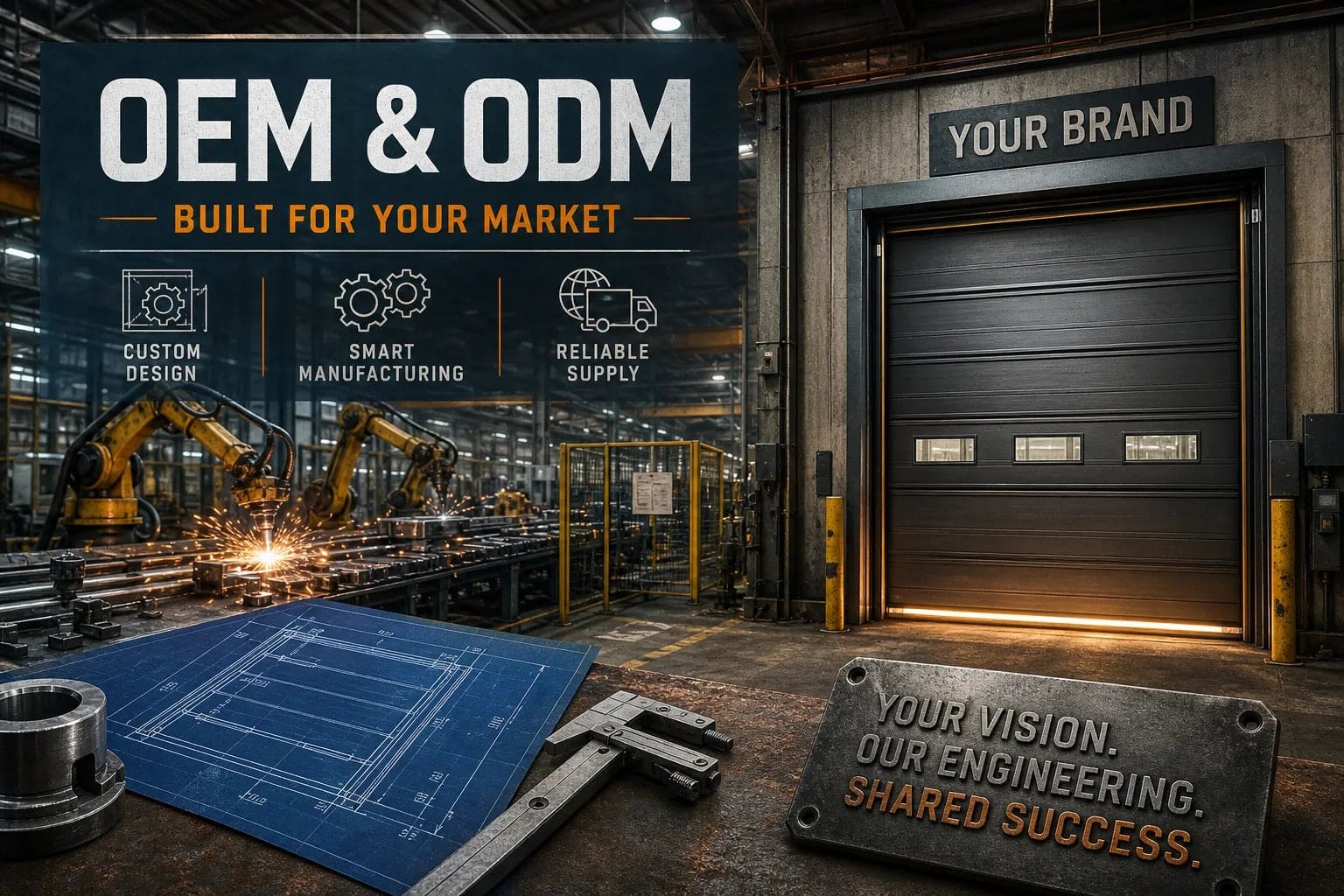
How does OEM/ODM work for industrial door distributors, OEM vs. ODM explained
OEM means you own the design. You bring the CAD files, dimensional specs, panel profiles, hardware configurations, and performance targets. The factory manufactures to your exact instructions. You’re not selecting from anything in their catalog; you’re handing them a blueprint. ODM works the opposite way: the factory already has an existing door platform, and you brand it, adjust dimensions or hardware, and sell it under your label. The base design is theirs, and your customization sits on top of it.
In concrete terms: OEM is what happens when a distributor brings a proprietary panel geometry or a patented hardware configuration to a factory and says, “Build this.” ODM is what happens when a distributor looks at a factory’s 80mm PU-insulated sectional door platform, picks a color, adds their logo, and says, “Label it as mine.” One starts from your IP; the other starts from theirs.
ODM is the faster entry point when you’re launching a private-label line for the first time without proprietary design IP, when you need speed to market more than a differentiated spec, or when you want to test demand under your own brand before committing to custom tooling. OEM is the right call once you have engineering that can’t be replicated from any factory’s existing catalog, patented features worth protecting, or a brand identity that requires a physically distinct product.
The distinction matters before you sign anything because it determines who owns the tooling, how long sampling takes, what your unit price structure looks like, and where IP liability sits. Get this wrong upfront, and you’ll spend months untangling it.
How OEM/ODM works: RFQ to first delivery for industrial door distributors
The process starts with a well-constructed RFQ. You define door type, clear opening dimensions, panel thickness, insulation performance targets, hardware, finish, compliance requirements (ANSI/DASMA, CE, UL for operators), quantities, and target delivery timeline. For OEM, you include 2D/DXF drawings and material specs. For ODM, you identify the base model you want and attach a change request list. Send this to shortlisted manufacturers, not a blast to 40 suppliers pulled from a directory search.
Before sharing any drawings or sensitive specs, get an NDA signed. This is non-negotiable on OEM projects where your design is the asset. The supplier’s feasibility review at this stage tells you whether your requested configuration is actually manufacturable, whether the dimensions require new tooling, and whether the requested compliance certifications exist for that configuration. If they skip this review, that’s a red flag.
Engineering confirmation follows the quote stage. For OEM, the factory converts your brief into production drawings and may flag design-for-manufacturability issues before tooling is cut. For ODM, they adapt their existing door platform with your agreed branding, color, modified hardware, and any dimensional changes. Standard ODM samples using an existing base design typically take two to four weeks. New ODM product development or OEM prototype builds run six to eight weeks. You review fit, function, panel finish, labeling placement, and packaging, then either approve or request revisions.
From purchase order to final delivery
After sample approval, you issue a purchase order and the factory runs a pre-production pilot batch to lock down process settings, verify labeling and manuals, and confirm packaging integrity before full production begins.
Final inspection checks the finished doors against the approved sample. Documentation prep covers compliance certificates, test reports, packing lists, and commercial invoices. Plan on roughly 30 to 45 days from sample approval to delivery for a standard ODM run, and 60 to 90 days for more complex OEM builds with new-product development steps involved.
MOQs, tooling costs, and manufacturing lead times you can plan around
Common factory MOQs for industrial sectional doors often fall in the 50 to 100 unit range, though actual minimums vary by supplier, door type, and whether tooling is required. As a general pattern, standard configurations using existing tooling tend to start around 50 units, while custom colors, non-standard dimensions, new panel profiles, or hardware configurations that require new tooling or production setup often push that threshold to 100 units or more. Marketplace listings showing minimums of two or three units reflect stocked items, not real factory OEM/ODM thresholds. When you’re sourcing industrial sectional doors at scale, 50 units is your practical floor for serious factory engagement.
Tooling fees only appear when the factory needs dies, molds, or profile extrusions that don’t already exist in their setup. ODM programs built on an existing door platform typically carry no tooling charge because the factory amortized that cost across its entire customer base long ago. OEM programs requiring new panel profiles or custom hardware configurations will carry tooling fees ranging from low thousands to well above $20,000 for precision steel molds, depending on complexity. Critically, tooling you pay for should contractually belong to you, with a clause requiring transfer or return if you change manufacturers.
Manufacturing lead times by door type break down like this: standard and lightly customized sectional doors typically run 25 to 45 days in production. High-speed doors with custom controls or non-standard curtain specs run 30 to 55 days. Full OEM programs involving new-product development and certification requirements extend to 60 to 90 days. Build a buffer into every customer commitment, especially when compliance documentation is part of the delivery package.
Private-labeling, ANSI/DASMA compliance, and what you must verify
White-label door production covers more ground than just putting a logo on a panel. It includes branded panel finishes and colors, private-label hardware (handles, locks, operators), custom packaging, installation manuals under your company name, and warranty cards with your contact details. A color change on an existing door is simple and adds minimal lead time. A fully rebranded product with custom documentation, branded packaging, and new installation manuals may add one to several weeks to the sampling timeline depending on artwork complexity and how many approval rounds are required.
ANSI/DASMA documentation is commonly required for US industrial sectional door permit submissions and is often essential in high-wind jurisdictions such as Florida and many Texas jurisdictions. ANSI/DASMA 102 governs industrial sectional door design and safety standards. DASMA 108 covers wind load performance testing, the key certification for building permit approval in Gulf Coast states where local codes require documented wind pressure ratings. DASMA 109 covers lifecycle spring performance. These certifications directly affect whether a door clears permit review. If you’re private-labeling a door, the certified configuration must match exactly what you’re ordering. Any dimension change, hardware swap, or panel modification may require re-testing and a new certification record.
Supplier quality assurance for doors: what your compliance package must include
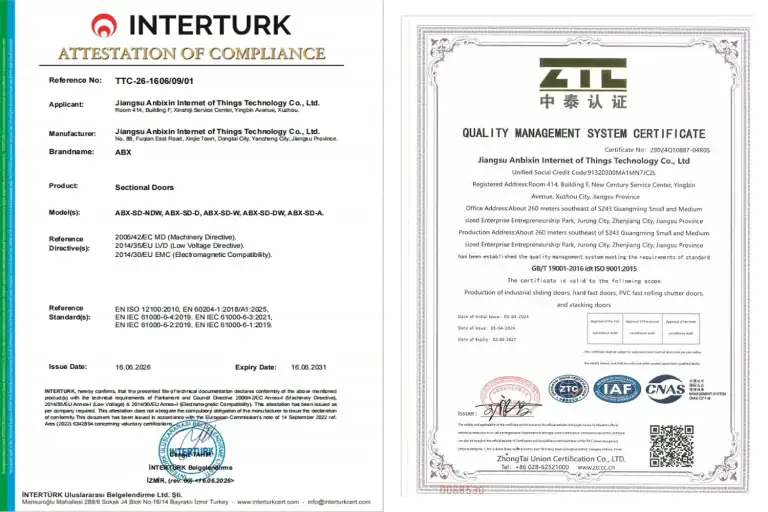
A complete compliance package from your manufacturer should include ANSI/DASMA test reports, CE and ISO certificates, UL listing evidence for motorized operators, installation manuals tied to the certified configuration, and CAD drawings formatted for US building permit submittals. Factories like ABX Doors that hold ANSI/DASMA 102, 108, and 109 compliance alongside CE and ISO 9001, 14001, and 45001 certifications give US distributors a ready-to-submit documentation set. That can materially reduce the back-and-forth with project approval authorities that stalls most overseas sourcing partnerships on US projects.
Contract terms every distributor should lock down before production starts
IP ownership needs to be explicit. All distributor-supplied design materials, brand assets, drawings, and product specifications are your property. The contract should state this clearly and grant the factory only a non-exclusive, revocable, limited manufacturing license to produce, test, package, and ship the contracted products. That license terminates immediately when the contract ends. Prohibit the factory from using your design for third parties, filing IP applications based on your materials, or reverse-engineering your configuration for their own catalog. These aren’t hypothetical risks; they’re documented failure modes in overseas OEM relationships.
Warranty allocation needs to run through two separate lanes. Manufacturing defects are the factory’s responsibility: dimensional errors, material failures, cosmetic defects traceable to production. Design defects in OEM arrangements fall on the distributor because the design is yours. In ODM arrangements, the split depends on how much the factory’s base design contributed to the failure. Set your warranty period at 12 to 24 months from delivery, define the claim procedure and evidence requirements, and specify who covers replacement costs, return freight, and any field labor costs when a defect traces back to manufacturing.
After-sales responsibility requires the manufacturer to support warranty investigations, provide failure analysis reports, and supply replacement parts for a defined period post-delivery. Cap the factory’s general liability where commercially appropriate, but carve out exceptions for confidentiality breaches, IP misuse, fraud, and indemnity obligations tied to manufacturing defects. Require the supplier to indemnify you for losses arising from unauthorized use of your brand assets or technical materials. These aren’t aggressive asks. Reputable manufacturers treat them as standard.
How ABX Doors structures OEM/ODM programs for US distributors
ABX Doors operates from a 36,000 square meter smart factory in Wuxi, China, with fully automated continuous production lines and fourth-generation robotics. Their client list includes GLP, UPS, JD.com, and Procter & Gamble, which reflects production capacity for large-scale, high-stakes programs. For US distributors, ABX offers private-label sectional door programs under which the distributor’s brand, colors, documentation, and warranty structure appear on a certified, production-proven door platform, without requiring a custom tooling investment to start.
Their compliance and documentation package covers ANSI/DASMA 102, 108, and 109 alongside CE, EAC, and ISO 9001, 14001, and 45001 certifications. Their VIP resource center gives distributor partners downloadable CAD drawings, TUV and CE motor certifications, wiring manuals, and technical spec sheets formatted for direct US building permit submission. This removes the documentation lag that typically stalls overseas OEM programs when permit reviewers ask for test evidence that most factories can’t produce quickly.
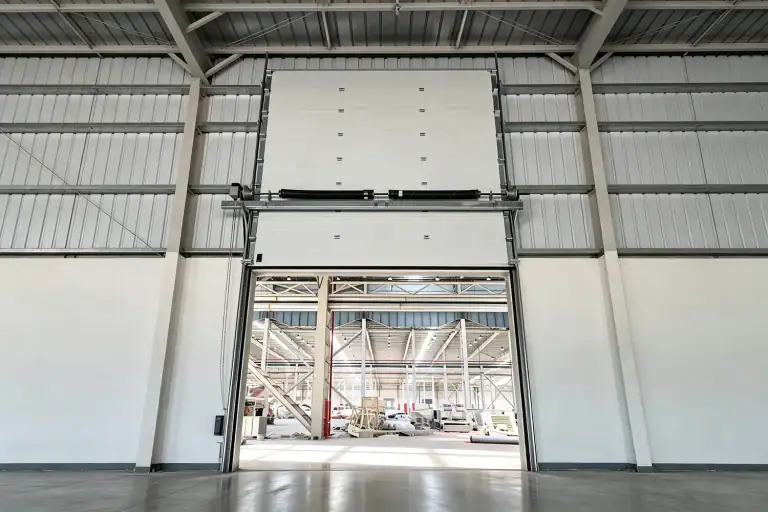
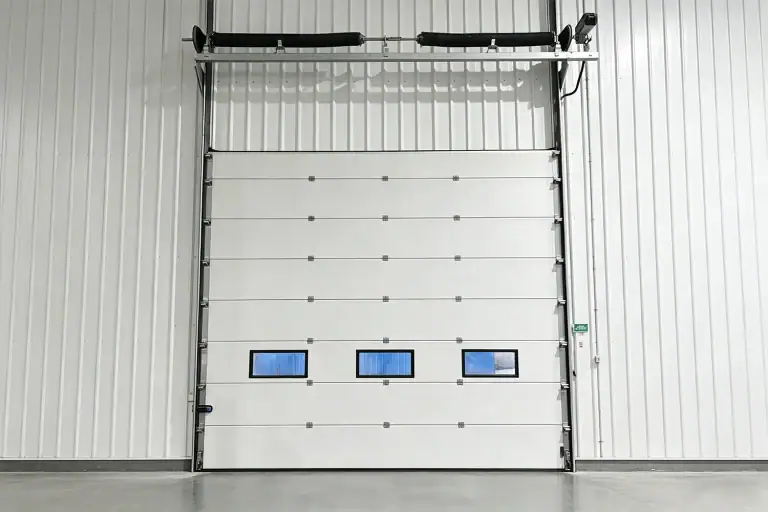
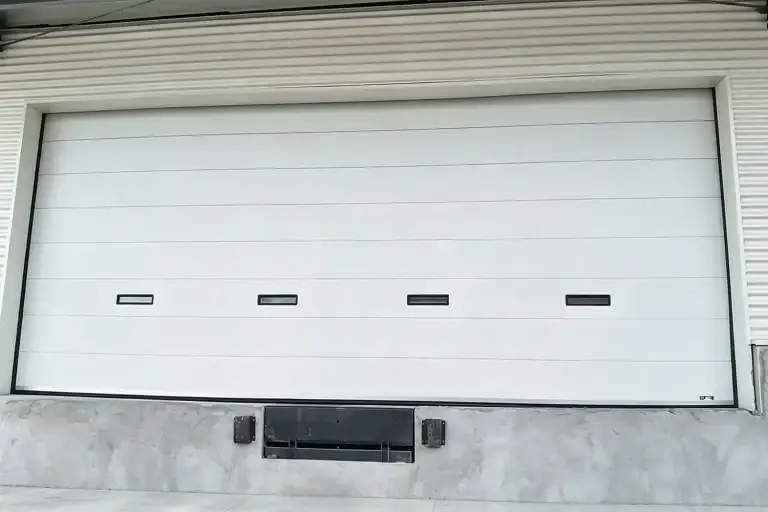
For distributors new to overseas sourcing, ABX’s ODM entry point is practical: their existing sectional door platform spans panel insulation options from 40mm to 80mm PU with openings up to 15 meters wide, all built on a certified base design with documented wind load and lifecycle performance data. You can private-label a certified, proven product, test demand under your brand, and scale into custom OEM specifications once volume justifies the tooling investment. Moving from ODM entry to OEM ownership is the natural progression, and it’s exactly how a sourcing relationship should develop.
Start with the right model, protect yourself with the right contract
Understanding how OEM/ODM works for industrial door distributors comes down to a clear decision framework: use ODM to launch fast and test your brand in the market; shift to OEM when you’re ready to own a proprietary product that no competitor can source from the same factory floor. Both paths work, but they serve different stages of a distributor’s growth and require different contract protections.
Lock down IP ownership, tooling rights, warranty allocation, and compliance documentation before production begins. The workflow itself is predictable when you know what to expect at each stage. What separates a partnership that protects you from one that doesn’t usually comes down to the contract signed before the first sample was ever produced.
If you want to understand how OEM/ODM works for industrial door distributors and explore next steps, contact ABX Doors directly. Their existing ANSI/DASMA compliance infrastructure means you’re not starting from zero on documentation, and their team can walk you through the program structure, MOQ thresholds, and compliance package in a single conversation.
CONTACT ABX
Your Direct Source for Industrial Access Solutions
We offer 24/7 support. Feel free to leave us a message — we'll reply within 24 hours.