Imported vs Domestic Industrial Doors: Full Comparison
When specifying overhead doors for mega-warehouses and logistics hubs, US procurement managers face a classic dilemma: Imported vs domestic industrial doors. Historically, domestic doors were viewed as the safe, high-quality choice, while imports were seen as budget alternatives. Today, advanced manufacturing automation has completely disrupted this narrative. This comprehensive comparison breaks down total cost of ownership, compliance, and quality benchmarks to help you make an informed sourcing decision.

1. Quality and Engineering Standards
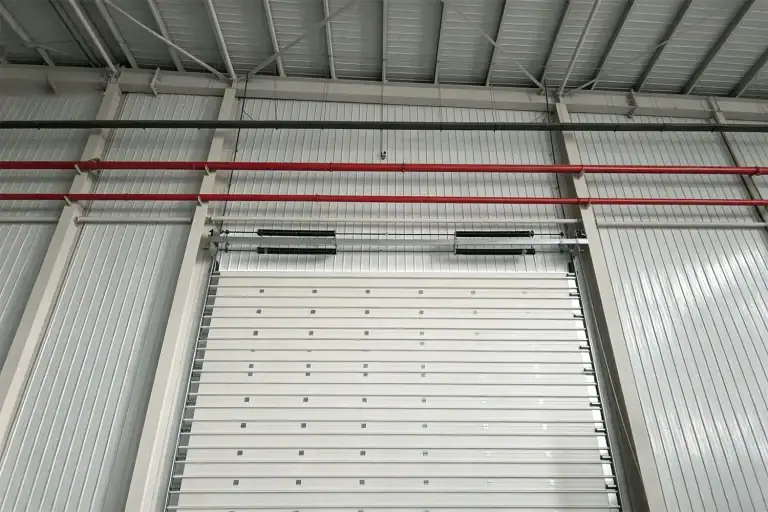
The myth of the ‘import quality gap’ is outdated. While low-tier overseas brokers still produce subpar goods, top-tier global OEMs now utilize manufacturing technology that often surpasses domestic factories. For example, premium imported doors feature high-density PU foam (45-48 kg/m³) and shot-peened torsion springs rated for 30,000+ cycles. As long as the imported door holds verifiable ANSI/DASMA 102, 108, and 109 testing data, its engineering quality is equal to—and often exceeds—domestic equivalents.
2. Total Cost of Ownership (TCO) and Pricing
Domestic doors carry a significant premium due to higher local labor and overhead costs. Imported doors from direct source manufacturers offer a massive upfront cost advantage. Even when factoring in trans-Pacific ocean freight and import tariffs, US distributors and facility developers can achieve 30% to 50% savings on large-scale projects. Because top-tier imports use heavy-duty hardware (like 1.8mm galvanized tracks), the long-term maintenance costs remain identical to premium domestic brands, resulting in a vastly superior TCO.
3. Lead Times and Supply Chain Reliability
Domestic manufacturers typically win on lead times for small, single-door orders. However, for large-scale logistics park developments requiring dozens of custom-sized doors, domestic factories often face supply chain bottlenecks. Mega-factories overseas, equipped with continuous production lines, can manufacture and ship high-volume orders with remarkable speed and consistency, making the overall project timeline highly competitive.
4. Why US Buyers Choose ABX Doors
ABX Doors bridges the credibility gap typically associated with foreign suppliers. We offer the cost advantages of an overseas manufacturer combined with the rigorous compliance of a domestic brand.
| Comparison Factor | The ABX Competitive Advantage |
|---|---|
| US Code Compliance | Full ANSI/DASMA compliance, ensuring zero friction during local building permit inspections. |
| Manufacturing Scale | A 36,000 sqm intelligent base with robotic workstations, guaranteeing zero-defect production for massive orders. |
| Client Validation | Trusted by Fortune 500 companies like P&G, GLP, and UPS, proving our reliability on the global stage. |
Make an Informed Sourcing Decision
You no longer have to choose between premium quality and project profitability. Contact the ABX engineering team to see how our imported industrial doors can optimize your next US development.
CONTACT ABX
Your Direct Source for Industrial Access Solutions
We offer 24/7 support. Feel free to leave us a message — we'll reply within 24 hours.