CE-Certified Industrial Doors: U.S. Import Guide 2026
Can I import CE certified industrial doors into the United States? The short answer is: not automatically. A CE mark gets your industrial doors into Europe, it does not get them into America. Many importers discover this the hard way, either at the border or during a permit review after the product is already on-site. The misconception is understandable: CE marking represents conformity with EU directives, the documentation looks official, and suppliers often present it as a universal quality credential. But U.S. regulators, customs authorities, and building officials operate from an entirely separate compliance framework.
Whether you’re a distributor sourcing from an overseas OEM, a logistics developer spec’ing a new facility, or a door dealer building a private-label line, the rules are the same. This guide covers what U.S. customs actually requires for imported industrial and automatic doors, which standards your product must meet, what changed with the July 2026 CPSC eFiling rule, and how to get through the process without costly delays. ABX Doors has built its compliance documentation program around U.S. market requirements, and by the end of this article, you’ll understand exactly why that distinction matters.
Can I import CE certified industrial doors into the United States?
What CE marking actually certifies
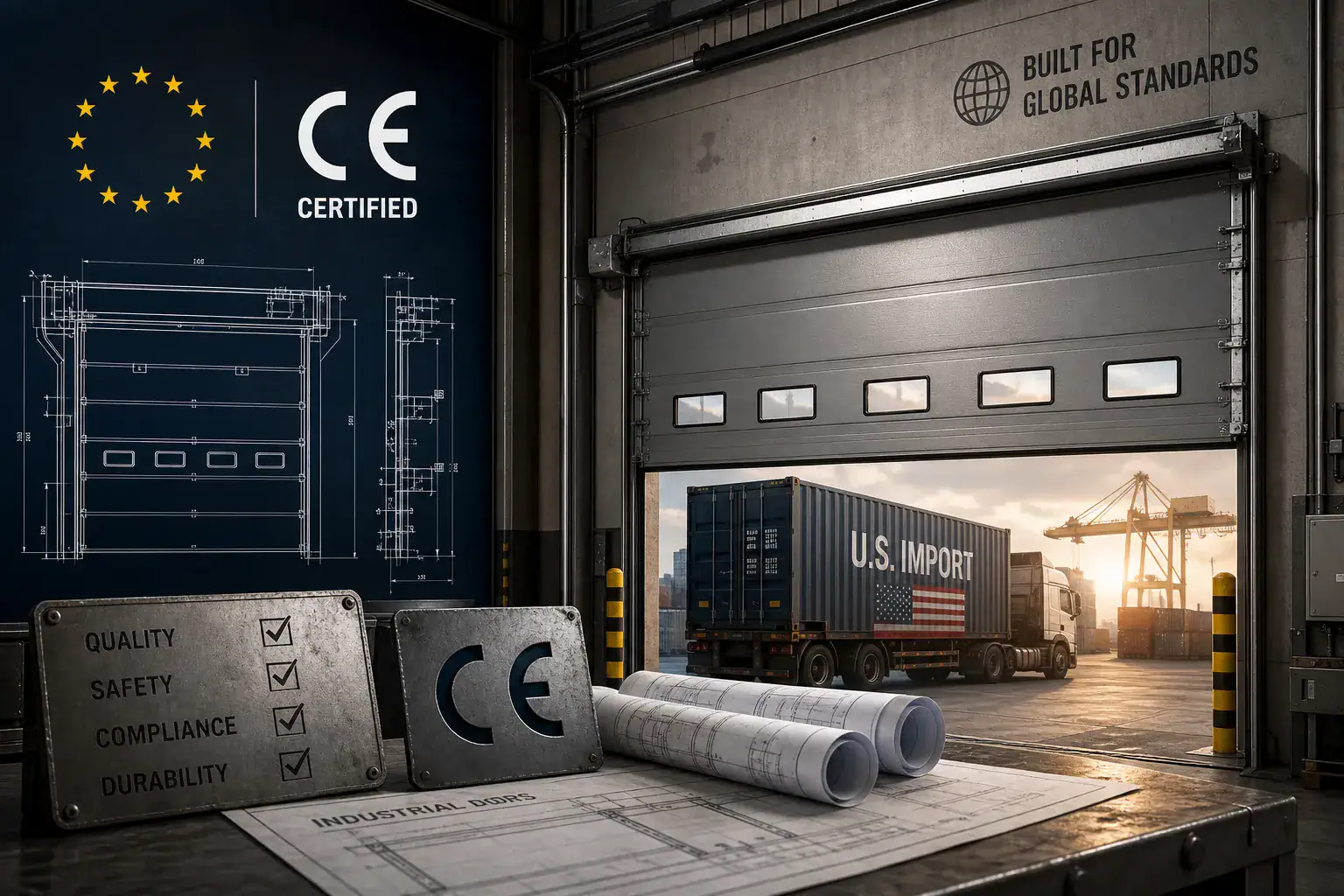
CE is an EU self-declaration system. It demonstrates that a product conforms to relevant EU directives covering health, safety, and environmental requirements for sale within the European Economic Area. Independent third-party testing is not required across all product categories, and CE marking carries zero legal weight inside U.S. borders. When your CE-marked doors arrive at a U.S. port, CBP evaluates them against U.S. standards, not EU directives.
The U.S.-EU Mutual Recognition Agreement: why it doesn’t help most importers
A bilateral Mutual Recognition Agreement exists between the U.S. and EU for certain listed product categories. Industrial sectional doors are not on that list. Even where the MRA does apply, it allows recognition of specific conformity assessment bodies, not the CE mark itself as a universal compliance pass. For most importers sourcing overseas doors, the MRA provides no practical benefit at U.S. entry.
How U.S. regulators treat CE documentation at entry
OSHA guidance states that CE marking is not comparable to a U.S. NRTL listing for electrical equipment. Building inspectors and Authorities Having Jurisdiction operate the same way: they look for U.S. standard compliance, not EU marks. A CE Declaration of Conformity is useful background documentation, but it will not satisfy a plan reviewer or a CBP officer asking for U.S. compliance proof.
U.S. standards that actually govern industrial and automatic doors
UL 325: the baseline for powered door operators
UL 325 is the primary U.S. safety standard for door, gate, and window operators. It covers entrapment protection, control circuitry, constant-pressure-to-close requirements, and monitoring of primary safety devices such as photo eyes and sensing edges. If your doors ship with motorized operators, those operators need NRTL listing under UL 325 to satisfy OSHA requirements and local electrical codes. An NRTL mark tells building inspectors and installers that an independent, recognized lab has evaluated the system, not just the manufacturer.
ANSI/DASMA standards for sectional industrial doors
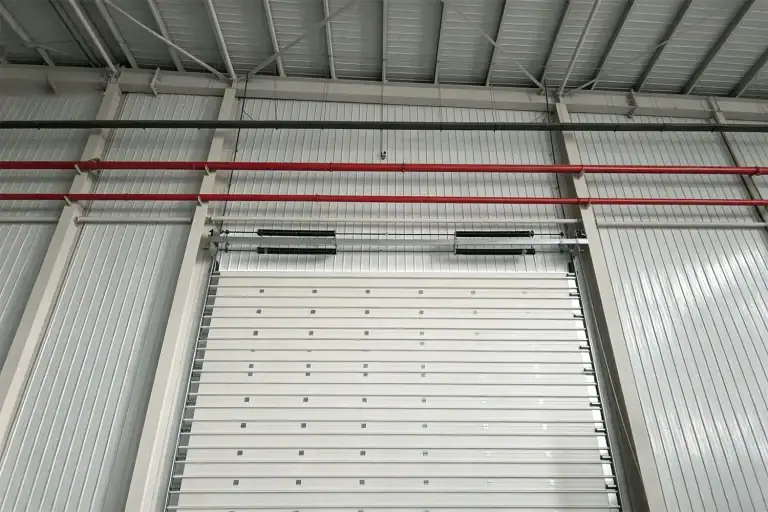
ANSI/DASMA 102, 108, and 109 are the three standards U.S. building officials commonly reference during permit review for heavy-duty overhead doors. DASMA 102 sets the design, component, labeling, and safety criteria for commercial and industrial sectional doors. DASMA 108 covers structural wind-load performance testing, non-negotiable for hurricane-prone states like Florida, Texas, and along the Gulf Coast. DASMA 109 addresses lifecycle performance, specifically the number of open/close cycles a door’s springs and hardware can sustain before failure. That last spec matters enormously in high-frequency logistics environments where a door may cycle hundreds of times per day.
Conformance is technically voluntary, but that distinction is rarely meaningful in practice. Local authorities and project specifications routinely require 102, 108, and 109 compliance as a condition of permit approval. If you can’t produce documentation for all three, expect your project timeline to slip.
ANSI/BHMA standards for automatic and high-speed doors
ANSI/BHMA A156.10 governs full-power automatic pedestrian doors. A156.19 covers low-energy and power-assist swinging doors but does not apply to industrial overhead or high-speed freight doors. IBC, NFPA 101, and local fire codes layer additional egress, accessibility, and fire-rating requirements depending on facility type and door location. Know which standard applies to your specific door category before ordering test reports, testing to the wrong standard wastes both time and money.
What documentation U.S. customs actually requires at entry
Standard customs entry documents every importer needs
Every commercial shipment requires a formal entry filed in ACE (CBP’s Automated Commercial Environment), along with a commercial invoice, packing list, and bill of lading. For industrial doors, country-of-origin documentation and composition substantiation are also required: bills of material and manufacturer declarations showing what the door is made of and where it was produced. These documents need to be accurate and consistent across every file, because discrepancies between invoice values and composition claims are a common trigger for CBP exams.
Section 232 reporting for steel and aluminum content
Many industrial sectional doors contain steel or aluminum and may be subject to Section 232 reporting obligations. When they do, you need melt and pour data for steel, or smelt and cast data for aluminum, along with origin documentation for the metals and a bill of materials showing weight or value breakouts for the metal content. Under current CBP guidance, importers must maintain sufficient documentation to support declared values for products classified as steel articles under HTS heading 7308 or aluminum derivative articles under heading 7610. Missing Section 232 documentation is a recognized cause of customs delays and unexpected duty assessments for industrial door shipments. Commit these documents in writing as a condition of your purchase order, not as an afterthought.
Third-party test reports and compliance certifications
A CE Declaration of Conformity does not substitute for U.S. compliance documentation. Importers should have accredited test reports from ISO/IEC 17025-accredited labs covering the applicable U.S. standards. For ANSI/DASMA testing, recognized labs include Architectural Testing, Inc. (an Intertek company) and American Test Lab Inc., both of which hold accreditation for DASMA 108. For fire-rated doors, a listing from a recognized certification body such as Intertek or QAI is typically required under IBC. Project specs and building permit submissions will demand these documents at approval stage, even if customs doesn’t flag the shipment at the port.
The July 2026 CPSC eFiling rule: what importers of industrial doors need to know
What the rule requires and who it targets
Effective July 8, 2026, importers of consumer products subject to CPSC mandatory safety standards must electronically file certificate data directly into ACE at the time of entry. This is a new filing step, not just a record-keeping requirement. The data elements required include product identification, the applicable consumer product safety rule, manufacture date and location, most recent test date, and testing lab information. Products entering from a Foreign Trade Zone have a later effective date of January 8, 2027, but standard ocean freight imports are subject to the rule now.
Does this rule apply to industrial doors?
For pure industrial and commercial sectional doors used in warehouses, logistics facilities, and manufacturing plants, CPSC jurisdiction generally does not apply, these are not consumer products. However, two edge cases deserve attention. Automatic doors installed in public retail or mixed-use spaces could trigger CPSC scrutiny, and door components imported as finished consumer products rather than commercial building materials could pull the product under CPSC’s scope. If your product classification is unclear, verify with your customs broker before the shipment departs. Per CPSC’s published ACE integration guidance, approximately 600 HTS codes have been flagged in ACE for review, and the list is not exhaustive.
What you must prove to import CE certified industrial doors into the United States
Why the supplier’s certifications are your documentation
The most practical way to de-risk a U.S. import program is to source from a manufacturer that has already done the compliance engineering work. At minimum, that means ANSI/DASMA 102, 108, and 109 compliance, UL-recognized motor certifications, and ISO 9001 quality system certification as a baseline indicator of manufacturing process control. Note that ISO 9001 is a supplier quality assurance credential, it is not itself a U.S. regulatory requirement, but its presence alongside accredited test reports and DASMA compliance declarations gives your customs broker and building permit reviewer a complete, coherent documentation package from day one. You’re not chasing paperwork across time zones after a vessel has already departed.
What ABX Doors provides U.S. importers
ABX Doors is a China-based industrial sectional door manufacturer that has built its product program around U.S. market compliance requirements. Their documentation package is designed to support U.S. customs entries and building permit submissions, covering ANSI/DASMA 102, 108, and 109 compliance alongside relevant international certifications. Their resource center gives architects, engineers, and importers downloadable CAD drawings, wiring manuals, motor certifications, and full technical spec sheets formatted for U.S. project approvals. For distributors and dealers building a private-label line, ABX’s OEM/ODM program is structured so that compliance documentation transfers to your brand without requiring you to build a compliance file from scratch, a meaningful advantage when you’re facing a permit review timeline or a customs entry deadline.
Steps to clear U.S. customs without delays or liability surprises
Before you place the order
Classify your product under the correct HTS code with your customs broker before the purchase order goes out. Misclassification causes delays, unexpected duties, and sometimes seizure. Confirm with your supplier whether Section 232 tariffs apply to the steel or aluminum content, and get the melt and pour documentation committed in writing as a condition of the order. This is also the stage to confirm which ANSI/DASMA test reports are available and whether the operator is NRTL-listed under UL 325.
Before the shipment leaves origin
Collect all compliance documentation at the manufacturing stage: ANSI/DASMA test reports, UL NRTL listing for the operator, country-of-origin declarations, and composition documentation. Do not wait until the shipment is on a vessel to track down missing certificates. Errors caught at origin cost days; errors caught at the port cost weeks and can result in CBP exams that hold the entire container.
After arrival: building permit and AHJ submission
U.S. compliance doesn’t end at customs. Your local Authority Having Jurisdiction will review product specifications against the applicable version of IBC and local amendments during permit review. Having the full technical package ready, DASMA compliance data, wind load test reports, cycle ratings, and operator NRTL listings, eliminates back-and-forth with plan reviewers and keeps your project on schedule.
Putting it all together
CE marking is a legitimate credential that reflects real engineering and conformity with EU directives. What it doesn’t do is satisfy U.S. building officials, customs authorities, or OSHA requirements. To import CE certified industrial doors into the United States, you need its own compliance proof: UL 325 NRTL listing for operators, ANSI/DASMA documentation for sectional door performance, accredited test reports, and Section 232 metal documentation for steel or aluminum content.
The July 2026 CPSC eFiling rule adds a new electronic filing step for consumer products, but most commercial industrial door imports fall outside its scope. Verify your HTS classification early, and if there’s any ambiguity about whether your product qualifies as a consumer good, resolve that with your broker before the shipment moves.
The most efficient path through this process is starting with a manufacturer who has already built U.S. compliance into their product program, one where documentation is ready before your vessel departs, not assembled under pressure at the port. If you’re evaluating sourcing options for a U.S. logistics, cold storage, or industrial facility project, contact ABX Doors to request their U.S.-market technical documentation package and evaluate it against your project requirements.
CONTACT ABX
Your Direct Source for Industrial Access Solutions
We offer 24/7 support. Feel free to leave us a message — we'll reply within 24 hours.