The dock leveler buying guide every warehouse needs
A wrong dock leveler decision doesn’t just cost money at the point of purchase. It creates daily bottlenecks, forklift instability risks, energy losses at the dock face, and expensive concrete work when you eventually have to retrofit the pit. This is a long-term infrastructure decision dressed up as an equipment purchase, and many buyers don’t approach it that way. This dock leveler buying guide gives you a complete loading dock leveler selection framework: actuation types, capacity specs, pit dimensions, OSHA compliance requirements, and true installed costs. By the end, you’ll know exactly what to ask before you commit to a single product.
Dock leveler buying guide: types and when each one makes sense
Pit-style levelers: the standard for high-traffic docks
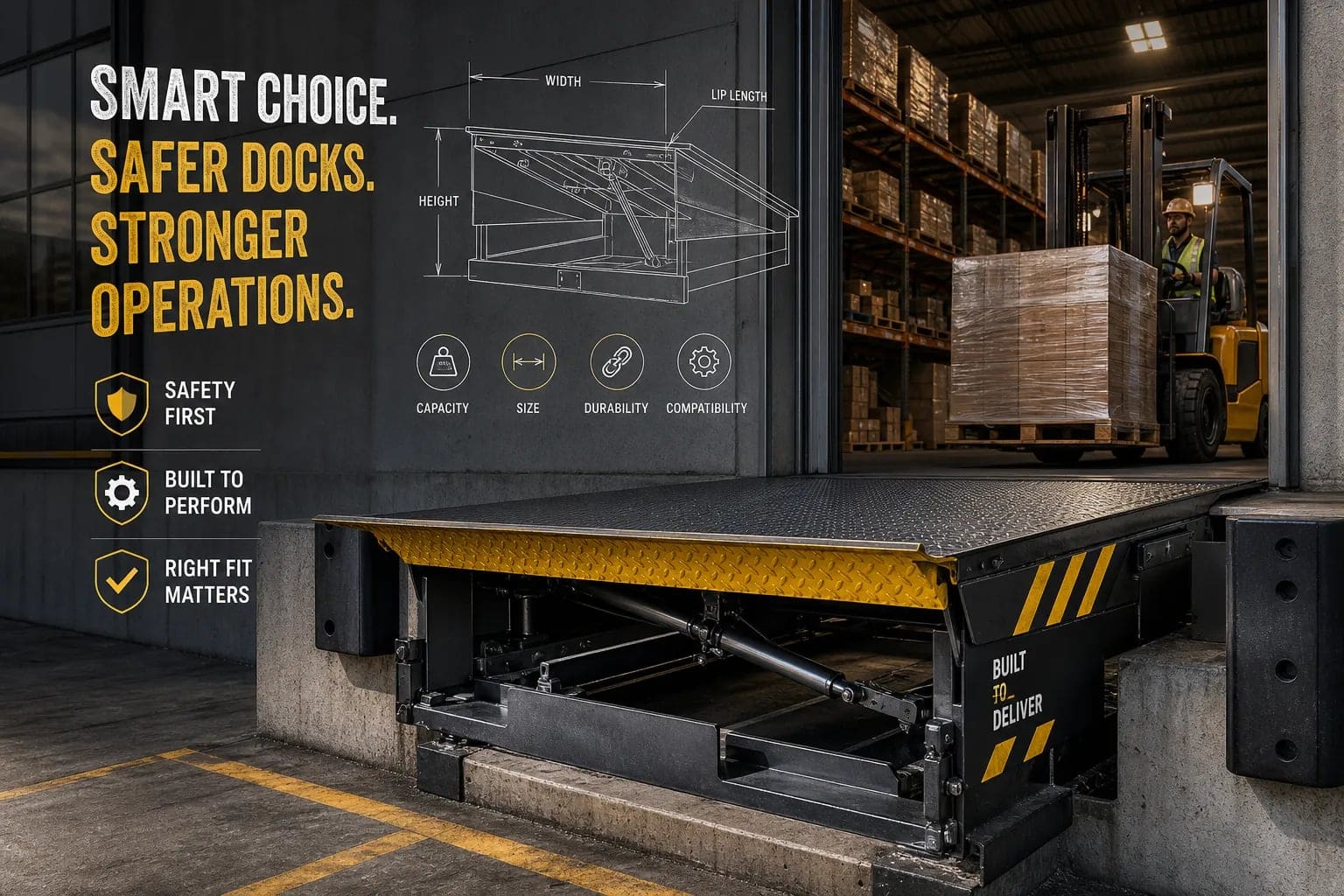
Pit-style levelers are mounted in a recessed concrete pit flush with the dock floor. They handle the widest range of truck bed heights, support forklift crossings, and are built for high daily cycle counts. If your dock serves a mixed fleet or runs multiple shifts, this is almost certainly your type.
Standard pit dimensions follow a consistent sizing rule: pit width equals deck width plus two inches, so a six-foot deck requires a 74-inch-wide pit. Pit length is typically 63 inches for six-foot units and 87 inches for eight-foot units. Standard pit depth runs approximately 20 inches at the front and 19.5 inches at the rear. Knowing these numbers before you pour concrete is non-negotiable.
Edge-of-dock levelers: low-cost option for predictable fleets
Edge-of-dock levelers bolt directly to the face of the dock wall. No pit is required, which keeps installation labor low and purchase prices in the $900 to $4,500 range. They work well when your truck bed heights are consistent and your daily cycle count is modest.
The tradeoff is real: edge-of-dock units have a limited vertical working range. If you receive common carriers, refrigerated trailers, and box trucks on the same door, the height variance alone will make this unit unsuitable. Don’t buy for your best-case scenario at a dock that regularly sees variability.
Vertical dock levelers: the cold-storage and food-grade choice
Vertical levelers store upright against the door opening when not in use, which creates a sealed dock face and dramatically reduces air infiltration. That’s why temperature-controlled facilities, pharmaceutical cold chains, and food-grade warehouses specify this type. The sealed position isn’t a bonus feature; it’s the reason the unit exists.
Expect purchase prices starting around $12,000 and rising with additional pit work, door coordination, and sealing requirements. This is the most expensive option in the category, but for a cold-storage dock where energy losses through the dock face can run into thousands of dollars per door annually, the payback calculation can justify the spec in high-energy-loss environments.
Hydraulic vs. mechanical vs. air-operated: real performance differences
Why most high-traffic warehouses default to hydraulic systems
Push-button operation, consistent cycle times, and significantly lower long-term maintenance frequency make hydraulic levelers the default for facilities running heavy daily loads. Operators don’t have to manually “walk” the deck into position or deal with spring tension adjustments. That consistency reduces both downtime and injury exposure.
The concern buyers raise most often about hydraulic units is oil leaks. Standard cylinder configurations place the rod and seal assembly in a position where road debris, dock contamination, and rod scoring accelerate seal failure. Some manufacturers address this with an inverted hydraulic cylinder design that shields the rod and seal area from the contamination responsible for most external leaks. ABX Doors’ H-1000 series uses this inverted-cylinder approach, along with heavy-gauge deck plates, to deliver a system that distributors can spec for demanding applications with confidence. This is the engineering detail that separates a premium OEM option from a catalog product.
Mechanical levelers: the case for simplicity and low upfront cost
Mechanical levelers require no electrical power at the pit and carry the lowest purchase price in the category. For a low-volume dock with a predictable, consistent fleet, that simplicity is a legitimate advantage. Repairs are straightforward and don’t require specialized hydraulic service.
Be direct about the long-term math, though. In high-cycle warehouse operations, mechanical levelers can run significantly higher annual maintenance costs than hydraulic units over a ten-year period, spring wear, manual adjustment frequency, and operator fatigue are the primary cost drivers. The upfront savings often disappear within the first few years of heavy operation.
Air-operated levelers: a middle ground worth understanding
Air-operated levelers deliver easier operation than mechanical units without the hydraulic fluid concerns. Operators use compressed air to raise and position the deck, which removes the manual effort and reduces fatigue on high-volume shifts. For facilities that already run compressed air infrastructure across the production floor, adding pneumatic dock levelers is a logical integration.
The tradeoff is infrastructure dependence. You’re adding compressors, air lines, valves, and pneumatic service points to the maintenance picture. If your facility doesn’t already have reliable compressed air capacity near the dock, this option adds capital cost before you buy a single leveler.
Dock leveler buying guide: capacity and spec requirements before you quote
How to read a dock leveler capacity chart
Rated capacity on a dock leveler is not just the weight of the load. It reflects the combined weight of the forklift, the load it’s carrying, and the dynamic forces of that weight crossing the deck. For a 6,000-pound forklift carrying a 4,000-pound load, you’re working with 10,000 pounds of gross vehicle weight. Apply the standard 2.5x safety factor and your minimum spec is 25,000 pounds, which means rounding up to the nearest standard size: typically 30,000 pounds.
The three most common capacity break points in the market are 35,000, 45,000, and 60,000 pounds. Undersizing this spec is one of the most expensive mistakes a facility manager can make, because a deck that flexes or deflects under repeated overload creates both structural damage and OSHA exposure. Always confirm the rated capacity with the lip fully extended, not just in the stored position.
Pit dimensions and dock lip length requirements
Standard lip length is 16 inches for most applications. Extended lip options of 18 and 20 inches are available when the height variance between dock floor and trailer bed is significant. Getting this wrong creates an unsafe crossing angle that causes forklift tires to lose contact with the deck surface, increases vehicle contact damage to trailer components, and creates instability that operators will work around unsafely.
Use the sizing formula consistently: pit width equals deck width plus two inches, and pit length matches your deck length. A six-foot deck needs a 74-inch-wide, 63-inch-long pit. An eight-foot deck needs an 87-inch pit length. If the concrete is already poured and the dimensions don’t match your target leveler spec, your options narrow significantly before you’ve made a single product decision.
Vertical working range and why it matters for mixed fleets
Working range is the above-and-below-dock elevation the leveler can bridge. A dock that exclusively receives a dedicated private fleet can specify a narrower range and reduce cost. A dock receiving common carriers, LTL trucks, refrigerated trailers, and lowboys on the same door needs the broadest range available.
This is one of the most commonly underspecified items in the loading dock leveler selection process. Facility managers often base the spec on their most frequent trailer type and discover the limitation six months later when an edge case creates an unsafe crossing or an equipment damage claim.
Site constraints that determine your final selection
Once your type and capacity specs are locked, site-specific conditions often make the final call. Cold-storage requirements, existing pit dimensions, and clearance constraints all narrow the product shortlist in ways that a catalog comparison won’t reveal.
Cold-storage and temperature-controlled dock requirements
Cold-storage docks require more than just a leveler with insulated panels. The entire dock opening needs to function as a climate barrier, which means the leveler selection is inseparable from the door seal and shelter selection. For facilities losing measurable energy through the dock opening, high-compression inflatable dock seals are worth specifying alongside the leveler. ABX Doors offers inflatable dock seals designed to create a tight perimeter seal for refrigerated and freezer dock applications, a meaningful upgrade over standard foam seals in high-loss environments.
Vertical levelers and inflatable dock shelters are frequently specified together in freezer dock installations precisely because both components are required to maintain interior temperature standards. Selecting one without planning for the other leaves a gap in the thermal envelope that a leveler alone cannot solve.
Structural and clearance constraints
If the pit is already poured, the depth and dimensions are fixed. A non-standard pit depth, say, 16 inches versus the standard 20 inches, immediately eliminates most standard product configurations and may require custom riser kits or specialty units that add lead time and cost. Confirm your actual pit dimensions before you shortlist any product.
The installation checklist items that site managers most commonly overlook include: electrical rough-in for hydraulic power units, ceiling clearance for vertical leveler storage in the upright position, and trailer restraint anchor points embedded in the dock face. Leaving these out of the installation scope creates change orders after the equipment has already arrived on site.
Safety features and OSHA compliance at the loading dock
What OSHA actually requires at dock levelers
OSHA’s dockboard rule under 29 CFR 1910.26 applies to dock levelers as devices that bridge the gap between the dock and vehicle. Lockout/tagout under 29 CFR 1910.147 applies during any maintenance operation on the leveler. Vehicle restraints are required to prevent trailer creep while workers are on or near the dock equipment.
OSHA also references ANSI MH30.1, the primary standard for the design, performance, and testing of dock leveling devices. Following manufacturer-recommended maintenance intervals and keeping written inspection records is widely required by permit authorities and insurance underwriters, treat it as a compliance baseline, not an optional best practice.
Safety features to require on any spec
Three safety requirements belong on every specification, regardless of leveler type. Safety legs or maintenance struts are non-negotiable: the leveler must hold itself safely in the raised position during service without relying on hydraulic pressure. Run-off protection is required for units placed into service after January 17, 2017. For hydraulic units, specify visible inspection ports and sealed cylinder housings that allow condition checks without full disassembly, a feature that simplifies compliance and shortens scheduled maintenance time.
Inspection frequency and documentation
Pre-use visual inspections by operators and periodic detailed inspections by qualified maintenance personnel are both required. The four items most commonly cited in OSHA dock inspections are hydraulic fluid levels, hose condition, structural integrity of the deck, and trailer restraint function. Damaged levelers must come out of service immediately. Leaving a damaged leveler in service or failing to follow required inspection intervals can lead to OSHA citations and exposes the facility to significant liability.
True cost of ownership: purchase, installation, and maintenance
What each leveler type actually costs to buy and install
Use these ranges as your planning benchmark:
- Edge-of-dock: $900 to $4,500 purchase; $1,400 to $5,000 installed (no pit work required)
- Pit-style mechanical: $5,500 to $11,000 installed
- Pit-style hydraulic: $7,000 to $12,000 installed at the base; full-featured systems with freight, anchoring, electrical rough-in, and commissioning can reach $13,700 to $35,620
- Vertical/cold-storage: $12,000 to $20,000+ with additional door and sealing coordination
For hydraulic systems specifically, common hidden costs include freight, anchoring hardware, electrical rough-in, and commissioning labor, line items that often don’t appear in a base equipment quote. Get a fully scoped proposal that itemizes every cost before you approve a purchase order.
Questions to ask vendors before you commit
Every vendor conversation should include these questions before you request a quote:
- What is the rated capacity with the lip fully extended?
- What is the required pit depth, and does it match our existing pit?
- What hydraulic cylinder configuration does this unit use, and where is the rod positioned?
- What is the warranty on the deck plate, cylinder, and seals separately?
- What ANSI and certification documentation is available for permit submission?
For facilities seeking building permit approvals or insurance underwriting, ANSI MH30.1 compliance documentation from the manufacturer is the standard reference. Ask for it in writing before the equipment ships.
Make the right call before the concrete is poured
The right dock leveler decision starts with your site measurements and your actual fleet data, not a product catalog. Confirm your pit dimensions, your daily cycle count, your truck bed height range, and your temperature control requirements before you compare a single model. Those inputs determine your type, your actuation system, your capacity spec, and your lip length. Use this dock leveler buying guide as your pre-purchase checklist, run through every section before you issue a request for quote.
For warehouse operators and distributors evaluating premium hydraulic dock systems, ABX Doors’ H-1000 series is worth a serious look. The inverted cylinder design reduces rod and seal exposure to contaminants, the most common source of hydraulic maintenance issues in standard configurations. The heavy-gauge deck plates exceed what most commodity catalog products offer. And the inflatable climate-seal system integrates directly with cold-storage door specifications for facilities that need the dock opening treated as a complete thermal barrier, not just a leveler position.
ABX Doors carries CE, ISO 9001, and ANSI/DASMA compliance documentation that simplifies both US import logistics and building permit submissions. With OEM/ODM flexibility and configurable production runs, ABX supports distributors and facility operators who need technical documentation, custom specifications, and certified product data, not just a catalog SKU. Request technical specifications or a quote directly from ABX Doors to get exact capacity charts, pit dimension requirements, and certified product documentation for your project.
CONTACT ABX
Your Direct Source for Industrial Access Solutions
We offer 24/7 support. Feel free to leave us a message — we'll reply within 24 hours.