2026-2027 Industrial Sectional Door Market Trends: What US Buyers Need to Know
As the global logistics and manufacturing sectors accelerate into the latter half of the decade, the demands placed on commercial building infrastructure are undergoing a radical transformation. For US-based facility developers, procurement directors, and regional distributors, relying on outdated procurement strategies or legacy hardware specifications is a recipe for shrinking margins and operational bottlenecks. The 2026-2027 industrial sectional door market is defined by a convergence of strict energy conservation mandates, the rapid adoption of Industry 4.0 automation, and a fundamental restructuring of the global supply chain. Understanding these macro-trends is essential for making future-proof sourcing decisions.
Trend 1: Hyper-Efficiency and Strict Energy Codes
The era of treating the loading dock door as a simple metal barrier is over. With the continuous updates to the International Energy Conservation Code (IECC) and state-specific environmental mandates, US building inspectors are scrutinizing the thermal envelope of commercial facilities more rigorously than ever before. In 2026, standard expanded polystyrene (EPS) insulation is rapidly becoming obsolete for climate-controlled warehouses.
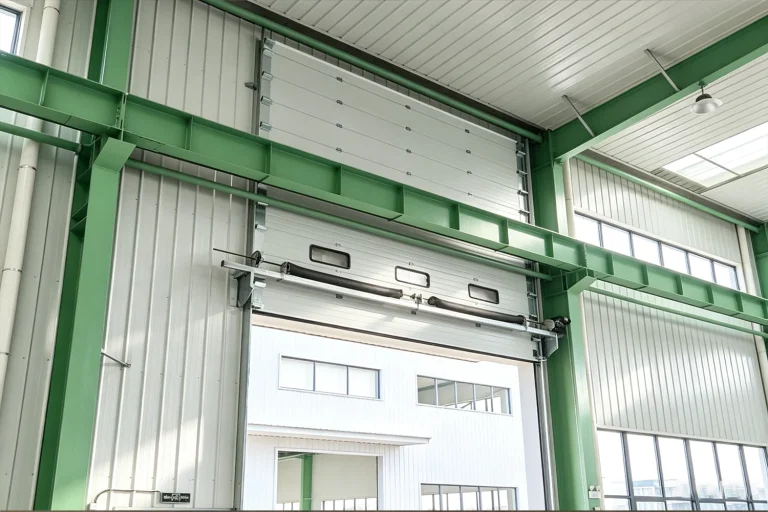
The market has decisively shifted toward high-density Polyurethane (PU) foam. Buyers are now specifying doors injected with CFC-free cyclopentane PU foam at densities of 45-48 kg/m³. Furthermore, to combat thermal bridging—a major source of energy loss and condensation—advanced manufacturers are integrating patented broken-bridge designs. These thermal breaks physically separate the interior and exterior steel skins. By combining 80mm high-density PU panels with broken-bridge technology, facilities can achieve R-values up to 17 (K≤0.8W/m³.K), drastically reducing HVAC electrical loads and ensuring compliance with the strictest 2027 energy codes.
Trend 2: Industry 4.0 and Smart IoT Integration
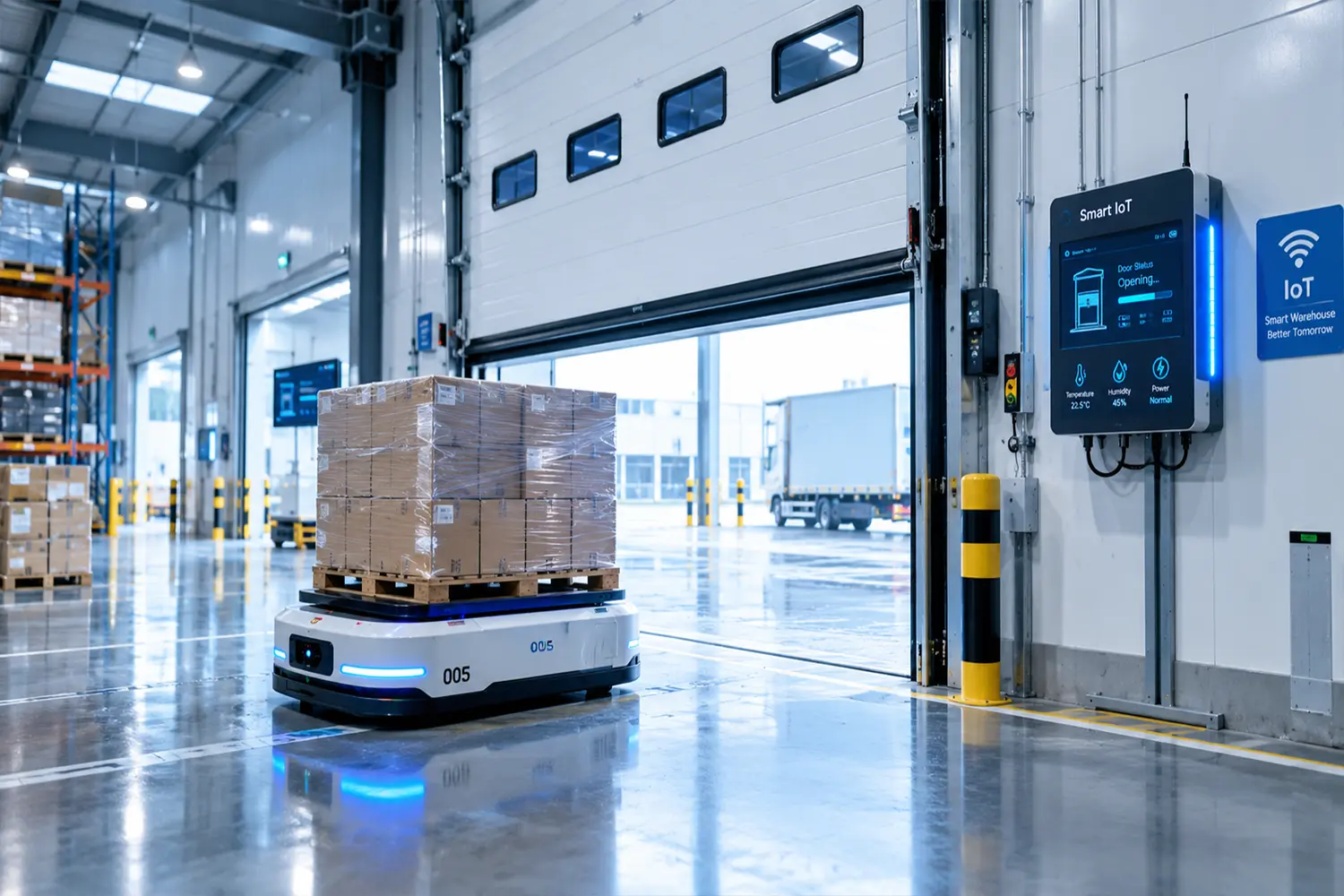
Automation is no longer restricted to the assembly line; it has reached the building envelope. As mega-warehouses deploy fleets of Automated Guided Vehicles (AGVs) and autonomous forklifts, industrial doors must integrate seamlessly into the facility’s digital ecosystem. A door that requires manual push-button operation is now a critical supply chain bottleneck.
The prevailing trend is the adoption of Smart IoT (Internet of Things) centralized control boxes. These advanced controllers replace legacy relay logic with microprocessors capable of bidirectional communication via industrial serial ports. This allows the sectional door to interface directly with the facility’s Distributed Control System (DCS) or Programmable Logic Controller (PLC) networks. When an AGV approaches, the system utilizes millisecond-response radar or geomagnetic sensors to trigger the servo motor, opening the door precisely in time for a zero-deceleration passage. Additionally, these IoT controllers harvest telemetry data—such as motor torque and spring cycle counts—enabling predictive maintenance that prevents unplanned loading dock downtime.
Trend 3: Extreme Weather Resilience and ANSI/DASMA Compliance
Driven by the increasing frequency of severe weather events, particularly along the US Gulf Coast and Eastern Seaboard, structural resilience is a top priority. Facility owners are demanding doors that can survive extreme barometric pressure fluctuations without compromising the building envelope.
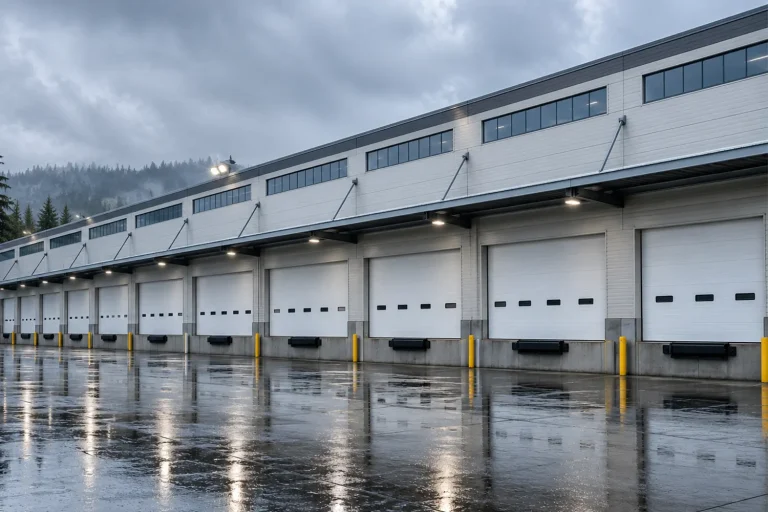
Consequently, verifiable compliance with ANSI/DASMA 108 (wind load testing) is a non-negotiable requirement for US buyers. Top-tier OEM manufacturers are responding by engineering heavy-duty sectional doors with integrated wind struts (U-bars) and 1.8mm galvanized bolt-on tracks. These reinforced systems are capable of withstanding wind pressures up to 700N/m², equivalent to a Category 12 Typhoon. This level of engineering ensures that the facility remains secure during catastrophic storms, protecting high-value inventory and reducing commercial insurance premiums.
Trend 4: The Rise of Direct-to-OEM Sourcing
Perhaps the most significant shift in the 2026-2027 market is the evolution of the supply chain itself. US regional distributors and large-scale contractors are increasingly bypassing domestic legacy brands and multi-tier trading companies. The brand premium charged by domestic manufacturers—often inflating prices by 30% to 50%—is no longer justifiable when the underlying raw materials and hardware specifications are identical.
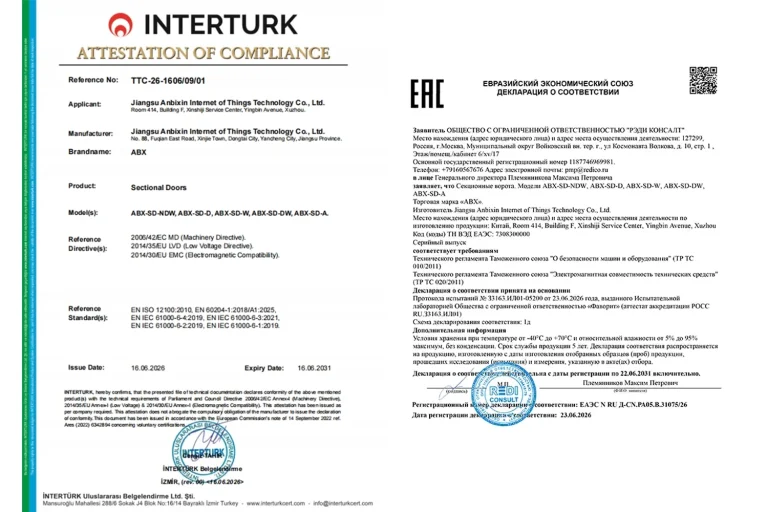
Instead, savvy US buyers are establishing direct partnerships with elite overseas OEM manufacturers. Factories that operate fully automatic continuous production lines and hold ISO9001/14001/45001 certifications offer Fortune 500-level quality at true wholesale pricing. Furthermore, premier OEMs now offer comprehensive DDP (Delivered Duty Paid) shipping, handling all US customs clearance, tariffs, and inland freight. This turnkey logistics approach eliminates the friction of international trade, allowing US distributors to launch highly profitable private label brands equipped with CE, EAC, and ANSI/DASMA certified hardware.
Future-Proofing Your Facility
Navigating the 2026-2027 industrial door market requires a strategic alignment with manufacturers who prioritize engineering innovation. By specifying high-density PU thermal breaks, Smart IoT integration, and rigorous ANSI/DASMA wind load compliance, US buyers can secure passage solutions that maximize operational ROI and meet the logistical demands of the next decade.
CONTACT ABX
Your Direct Source for Industrial Access Solutions
We offer 24/7 support. Feel free to leave us a message — we'll reply within 24 hours.