What R-Value Do Cold Storage Doors Need?
In cold chain logistics, temperature integrity is everything. A poorly insulated loading dock door forces HVAC and refrigeration systems into overdrive, skyrocketing energy bills and risking the spoilage of pharmaceutical or food-grade inventory. When specifying insulated sectional doors for cold storage facilities, understanding and selecting the correct R-value is the most critical procurement decision a facility manager will make.
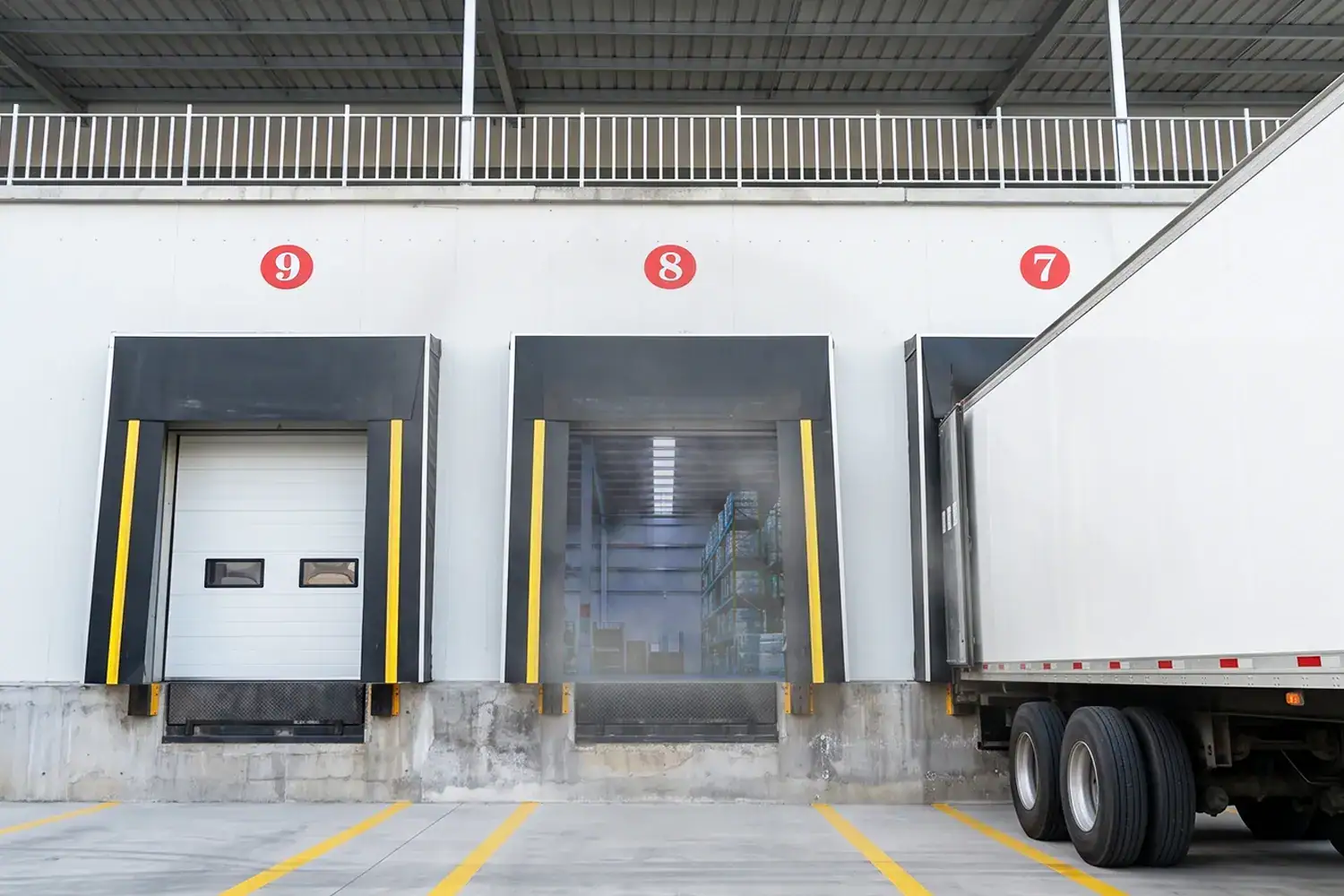
1. Understanding R-Value in Cold Storage
R-value measures a material’s thermal resistance—its ability to prevent heat from transferring through it. The higher the R-value, the better the insulation. For industrial doors, the R-value is determined by the core insulation material, its density, and the thickness of the door panel. It is important to note that a door’s overall thermal efficiency also depends on eliminating thermal bridging and ensuring airtight perimeter seals.
2. Calculating Required R-Values: Coolers vs. Freezers
The required R-value depends entirely on the temperature differential between the inside of the facility and the ambient outside environment.
- Coolers and Chillers (32°F to 50°F / 0°C to 10°C): Facilities storing fresh produce or beverages typically require industrial doors with an R-value between R-10 and R-14.
- Freezers and Deep Cold (-20°F to 0°F / -29°C to -18°C): Frozen food storage and pharmaceutical cold chains demand maximum thermal resistance. These environments require heavy-duty doors with an R-value of R-15 to R-17 or higher to prevent rapid temperature loss and condensation buildup.
3. The Role of PU Foam Density and Thickness
Not all insulation is created equal. Standard expanded polystyrene (EPS) degrades over time and offers lower thermal resistance per inch. Premium cold storage doors utilize injected Polyurethane (PU) foam.
At ABX Doors, we manufacture our insulated sectional doors using CFC-free cyclopentane PU foam with an exceptionally high density of 45-48 kg/m³ and a closed-cell rate exceeding 95%. By offering panel thicknesses ranging from 40mm to 80mm, we allow facility designers to precisely match the door to their required R-value.
| ABX Panel Thickness | Typical Application | Thermal Performance |
|---|---|---|
| 40mm – 50mm PU Panel | Standard Warehouses, Coolers, Loading Docks | Excellent baseline insulation, significantly reducing HVAC loads. |
| 80mm PU Panel | Deep Freezers, Pharmaceutical Cold Chain | Maximum thermal resistance, achieving an R-value up to 17 and K≤0.8W/m³.K. |
4. Eliminating Thermal Bridging
A high R-value panel is useless if the metal frame conducts heat. ABX Doors utilizes a patented broken-bridge anti-pinch design (ZL201220623912.0) that physically interrupts the conductive path between the interior and exterior metal skins, preventing frost buildup and energy loss.
Optimize Your Cold Chain Efficiency
Stop losing money through poorly insulated dock doors. Partner with ABX Doors for high-density PU insulated solutions tailored to your specific temperature requirements. [Internal Link Placeholder: Download our cold storage door technical specifications] and contact our engineering team for a custom energy-saving quote.
CONTACT ABX
Your Direct Source for Industrial Access Solutions
We offer 24/7 support. Feel free to leave us a message — we'll reply within 24 hours.