Overhead Security Doors: Protecting High-Value Inventory in Logistics Hubs
In the modern global supply chain, mega-logistics hubs and distribution centers are essentially high-yield bank vaults. Facilities storing pharmaceuticals, consumer electronics, aerospace components, and luxury goods face an ever-evolving threat matrix from organized cargo theft. While facility managers invest heavily in perimeter fencing, surveillance cameras, and access control systems, the loading dock often remains the most glaring structural vulnerability. Standard commercial doors can be breached in minutes using basic tools or vehicles. To truly protect high-value inventory, security directors and facility architects must specify heavy-duty overhead security doors engineered to withstand aggressive forced entry, ram-raiding, and environmental sabotage.
The Vulnerability of Standard Commercial Doors
To understand the necessity of security-grade doors, one must analyze how standard doors fail during a breach. Traditional commercial overhead doors are often constructed with single-layer 24-gauge steel or filled with low-density expanded polystyrene (EPS). These materials offer minimal resistance to cutting tools like reciprocating saws or angle grinders. Furthermore, standard 1.5mm tracks and basic roller hinges can be easily compromised by leveraging a pry bar under the bottom panel, effectively popping the door out of its tracks. In more extreme scenarios, thieves utilize ‘ram-raiding’ tactics, backing a stolen truck directly through the closed door to gain instant access to the warehouse floor.
The Anatomy of a Security-Grade Sectional Door
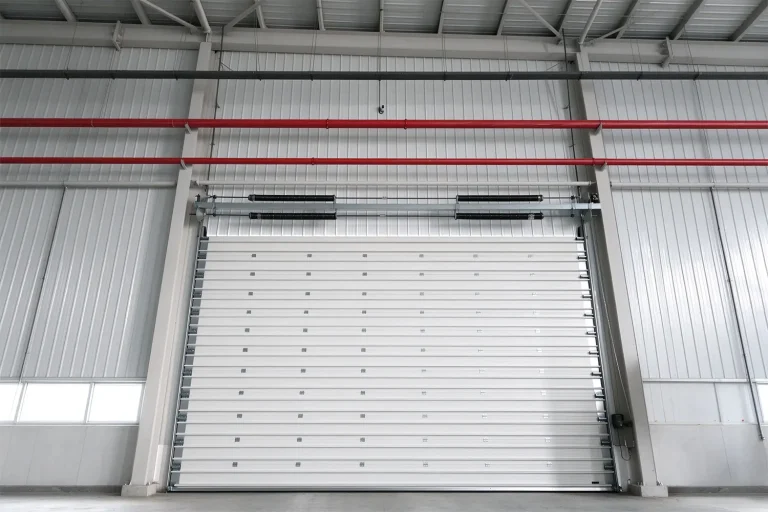
Defeating sophisticated intrusion attempts requires a multi-layered engineering approach. A true overhead security door acts as a composite armor shield, integrating high-tensile metallurgy with structural rigidity.
Composite Panel Rigidity
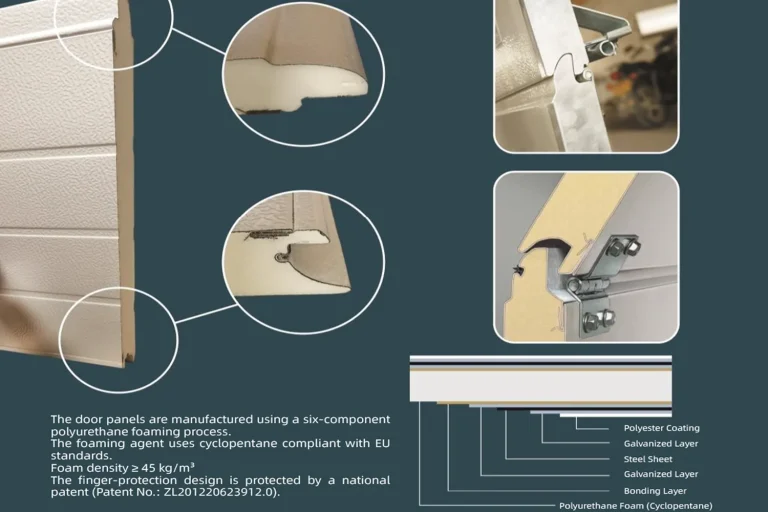
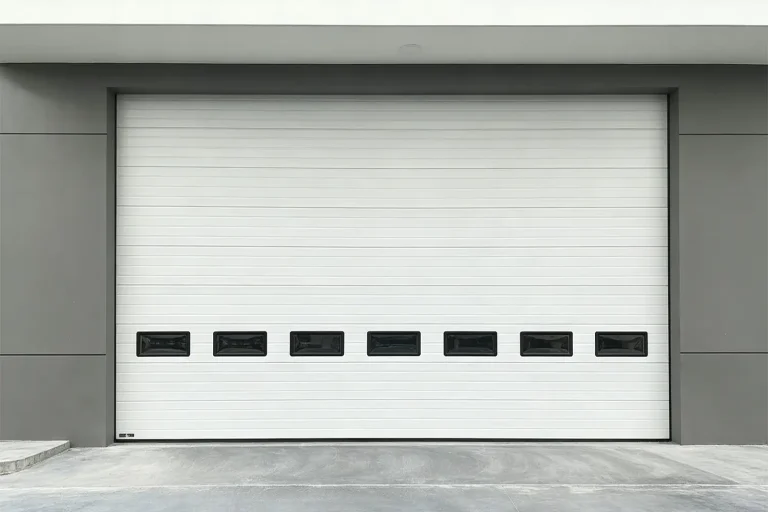
The first line of defense is the door panel itself. Security-grade sectional doors utilize a double-layer steel skin construction. However, the true strength lies in the core. Premium manufacturers inject CFC-free cyclopentane Polyurethane (PU) foam at an exceptionally high density of 45-48 kg/m³. Unlike EPS blocks, this injected PU foam expands and chemically bonds to the interior and exterior steel skins. This creates a monolithic, composite structure. When a cutting tool or blunt force is applied, the high-density core prevents the steel skins from crushing or buckling inward, exponentially increasing the time and effort required to breach the panel.
Defeating Pry Attacks: Track and Hardware Integrity
If thieves cannot cut through the door, they will attempt to pry it open or lift it off its tracks. This is where heavy-duty hardware becomes critical. Security doors must be specified with 1.8mm to 2.0mm heavy-duty galvanized steel tracks. Crucially, these tracks must utilize secure bolt-on connections rather than spot welds, which can fracture under intense prying leverage. Additionally, the door should be equipped with anti-lift devices and heavy-duty closed tubular hinges that resist deformation, ensuring the panels remain permanently locked within the track system even under extreme mechanical stress.
Smart IoT Integration for Active Security
Physical fortification is only half of a modern security strategy; the other half is active intelligence. In 2026, passive steel doors are being replaced by active security nodes. By integrating Smart IoT (Internet of Things) control boxes, overhead security doors become an extension of the facility’s overarching alarm and DCS (Distributed Control System) networks.
These smart controllers continuously monitor the door’s status. If the motor detects an unauthorized manual lifting attempt, or if integrated vibration sensors detect the frequency of a cutting tool or a vehicle impact, the IoT control box instantly triggers a localized alarm and transmits a high-priority alert to the central security dashboard. Furthermore, these systems can be programmed to automatically lock down adjacent bays or activate high-intensity strobe lighting to disorient intruders, transforming the door from a passive barrier into an active deterrent.
Balancing Security with Operational Throughput
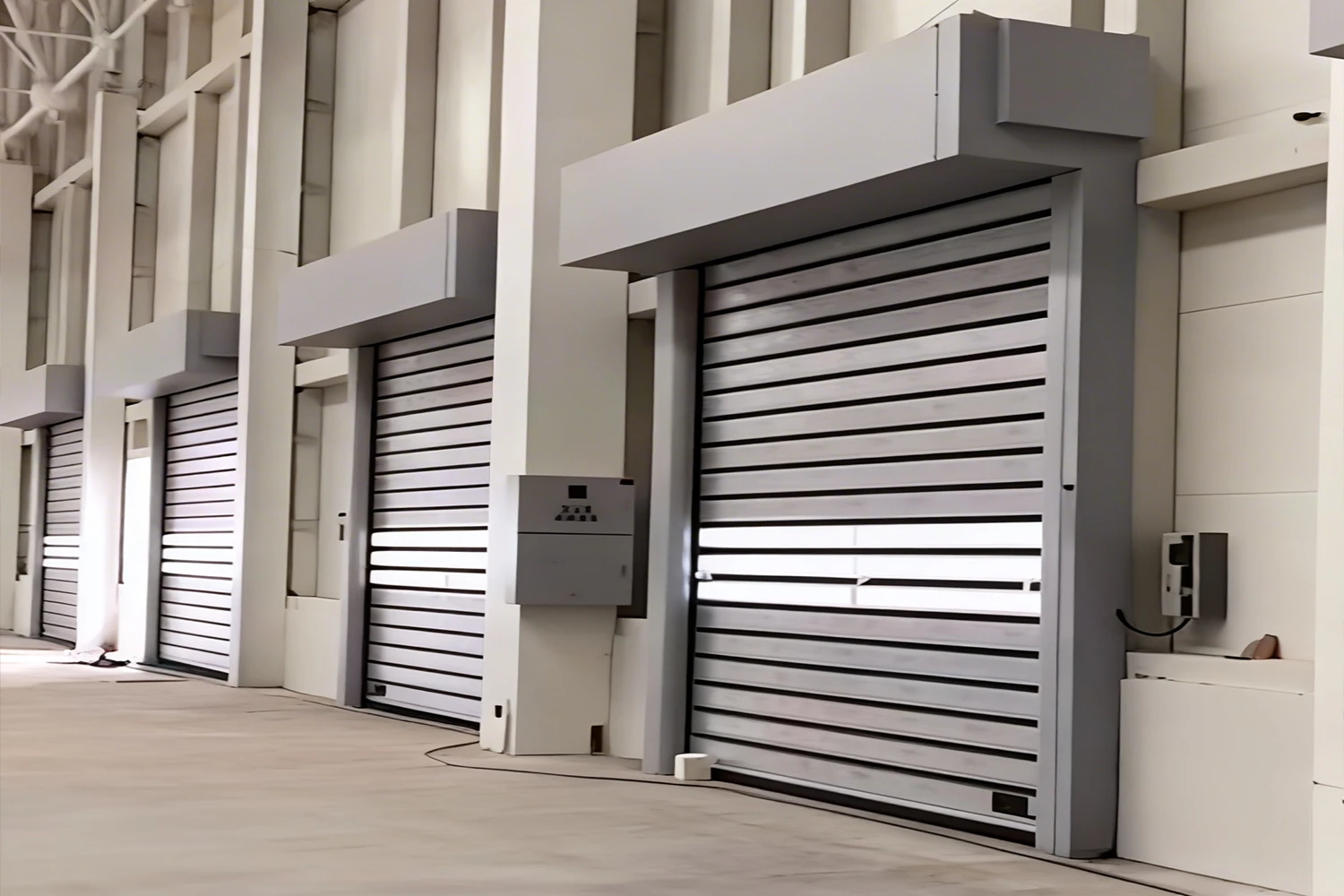
A common misconception is that heavily armored doors are too slow or cumbersome for high-traffic logistics centers. However, advanced engineering allows facilities to achieve maximum security without sacrificing operational efficiency. By pairing heavy-duty composite steel panels with industrial-grade 55CrSi or 60Si2Mn torsion springs (rated for 30,000+ cycles) and CE/TUV certified high-torque motors, these doors operate smoothly and reliably. For bays requiring continuous 24/7 forklift traffic, facility managers can deploy a hybrid solution: utilizing a high-speed servo-driven roll-up door for rapid daytime operations, backed by a heavy-duty sectional security door that locks down the bay during non-operational hours.
Securing the Supply Chain
Protecting high-value inventory requires eliminating the weakest links in the building envelope. By specifying overhead security doors with high-density PU composite panels, anti-pry track systems, and Smart IoT integration, logistics developers can effectively neutralize the threat of cargo theft. Investing in purpose-built security infrastructure not only protects millions of dollars in inventory but also significantly reduces commercial insurance premiums, delivering a robust return on investment for high-stakes supply chains.
CONTACT ABX
Your Direct Source for Industrial Access Solutions
We offer 24/7 support. Feel free to leave us a message — we'll reply within 24 hours.