Wind Load Doors: Navigating ASCE 7 and ANSI/DASMA 108 for Coastal Facilities
Constructing and managing industrial facilities in coastal regions presents a unique set of architectural and engineering challenges. Among these, extreme weather and hurricane-force winds pose the greatest threat to a building’s structural envelope. The loading dock is typically the most vulnerable point of this envelope. If a standard commercial overhead door fails during a severe storm, the resulting internal pressurization can lead to catastrophic structural damage, including roof blow-offs and massive inventory loss. For facility developers, architects, and general contractors, specifying the correct wind load doors is not merely a best practice—it is a strict legal and safety mandate. This comprehensive guide explores the physics of wind load, decodes the ASCE 7 and ANSI/DASMA 108 standards, and explains how to specify heavy-duty sectional doors for coastal resilience.
The Physics of Wind Load on Industrial Doors
To understand why specialized doors are required, one must first understand how wind interacts with a large-format building opening. Wind load is not simply the force of air blowing against the door; it involves complex aerodynamic pressures that fluctuate rapidly during a storm event. These forces are categorized into two primary types of pressure:
- Positive Pressure: This is the direct force of the wind pushing inward against the exterior surface of the door panels. If the door lacks structural rigidity, positive pressure will cause the panels to buckle, fold, and ultimately collapse inward, breaching the facility.
- Negative Pressure (Suction): As high-speed wind flows over and around the building, it creates a vacuum effect on the leeward side or inside the building if another opening is breached. This negative pressure pulls the door outward. In many storm failure analyses, doors do not blow in; they are sucked out, ripping the roller assemblies completely out of the track system.
A true wind-rated industrial door must be engineered to withstand both extreme positive and extreme negative pressures simultaneously without permanent deformation or hardware failure.
Decoding ASCE 7 and Building Codes
In the United States, wind load requirements are heavily regulated by local building codes, such as the Florida Building Code (FBC) or the International Building Code (IBC). These codes rely on the foundational standards set by the American Society of Civil Engineers, specifically ASCE 7 (Minimum Design Loads and Associated Criteria for Buildings and Other Structures).
ASCE 7 provides the methodology for calculating the required Design Pressure for any specific building component. Design Pressure is typically measured in Pounds per Square Foot (PSF) or Newtons per Square Meter (N/m²). The required PSF for an industrial door is calculated based on several variables:
- Basic Wind Speed: The historical maximum wind speed for the geographic region (e.g., 170 mph in High-Velocity Hurricane Zones like Miami-Dade County).
- Exposure Category: The terrain surrounding the building. A warehouse on an open coastline (Exposure D) faces much harsher wind dynamics than one surrounded by dense city buildings (Exposure B).
- Building Height and Door Location: Wind speeds increase with height, and pressures are concentrated at the corners and edges of a building. A door located at the corner of a facility will require a higher wind load rating than one in the center of the wall.
The ANSI/DASMA 108 Testing Protocol
Calculating the required design pressure is only the first step. Building inspectors require verifiable proof that the manufactured door can actually withstand that pressure. In North America, the gold standard for this verification is ANSI/DASMA 108 (Standard Method for Testing Sectional Garage Doors and Rolling Doors: Determination of Structural Performance Under Uniform Static Air Pressure Difference).
During an ANSI/DASMA 108 test, the fully assembled sectional door is installed in a specialized testing chamber. The chamber simulates severe storm conditions by applying uniform static air pressure to both the interior and exterior faces of the door. To achieve certification, the door must sustain the specified design pressure for a set duration without the panels buckling, the hinges shearing, or the rollers disengaging from the tracks. Furthermore, the door must remain fully operable after the test is concluded.
Engineering a Category 12 Typhoon-Rated Door
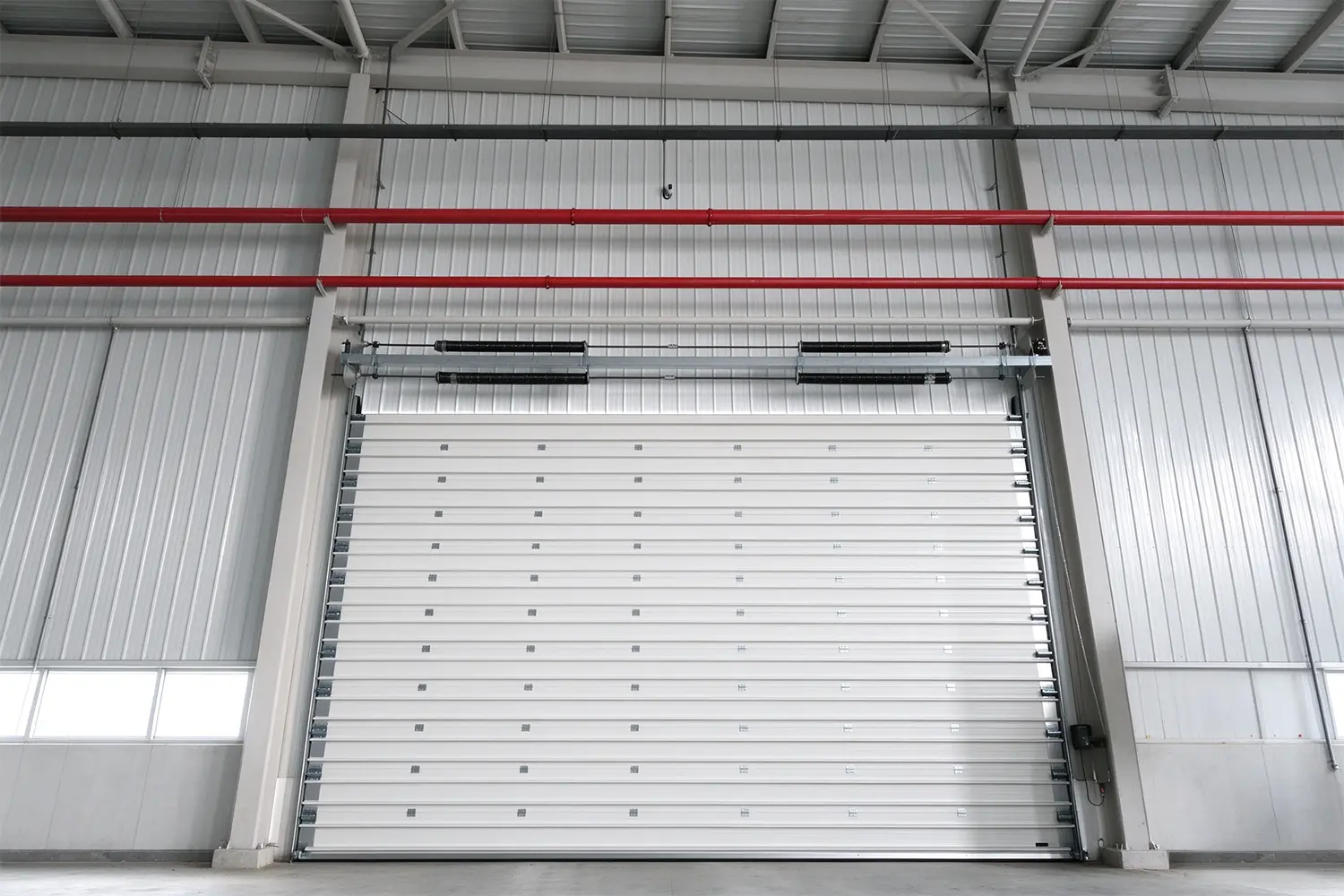
Meeting these rigorous standards requires a departure from standard commercial door manufacturing. ABX Doors engineers heavy-duty industrial sectional doors specifically designed to exceed coastal compliance requirements, achieving wind resistance up to 700N/m² (equivalent to a Category 12 Typhoon). This level of resilience is achieved through a combination of advanced materials and structural reinforcements.
1. Structural Wind Struts (U-Bars)
To combat positive pressure and prevent panel deflection, heavy-duty galvanized steel wind struts (often referred to as U-bars) are integrated across the interior face of the door panels. The number and depth of these struts are mathematically calculated based on the door’s width and the target PSF rating. For extreme coastal applications, multiple high-profile struts are utilized to ensure the door remains rigid under hurricane-force impacts.
2. High-Density PU Insulation for Structural Rigidity
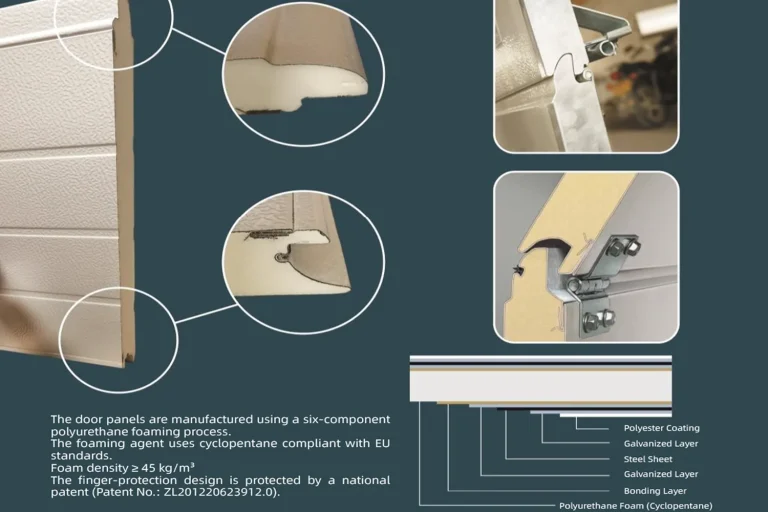
While Polyurethane (PU) foam is primarily known for its thermal insulation properties (R-value), it plays a crucial role in wind load resistance. ABX Doors injects CFC-free cyclopentane PU foam at a high density of 45-48 kg/m³. Unlike expanded polystyrene (EPS) blocks, injected PU foam expands to fill 100% of the panel cavity and chemically bonds to the interior and exterior steel skins. This creates a monolithic, composite structure that exponentially increases the panel’s overall bending strength and resistance to wind deflection.
3. Heavy-Duty Track and Roller Systems
To combat negative pressure and prevent track pull-out, the hardware must be upgraded. Standard 1.5mm tracks are insufficient for coastal zones. ABX utilizes 1.8mm heavy-duty galvanized steel tracks. Crucially, these tracks feature secure bolt-on connections rather than spot welds. Welding destroys the galvanized coating and creates brittle stress points. Bolt-on tracks maintain their anti-corrosion properties and offer superior flexibility under dynamic wind stress. Paired with long-stem, precision-bearing nylon rollers, the door remains securely locked within the building envelope regardless of the suction force.
Ensuring Coastal Compliance and Facility Security
Specifying wind load doors is a complex engineering task that directly impacts the safety and legality of a commercial facility. By understanding the dynamics of ASCE 7 and demanding verifiable ANSI/DASMA 108 testing data, procurement managers and architects can confidently protect their logistics hubs from extreme weather. Partnering with a certified OEM manufacturer ensures that your facility is equipped with passage solutions engineered for ultimate coastal resilience.
CONTACT ABX
Your Direct Source for Industrial Access Solutions
We offer 24/7 support. Feel free to leave us a message — we'll reply within 24 hours.