Are ANSI/DASMA Standards Required for Industrial Doors?
Do industrial doors need to be ANSI/DASMA compliant in the United States? Here is the compliance reality most facility owners miss: ANSI/DASMA standards are not federal law. No single federal agency requires them on industrial doors as a standalone legal mandate. If you stopped reading there, you might conclude compliance is optional and move on. That conclusion could stall your building permit, void your insurance coverage after a wind event, or put you in front of a liability attorney explaining why your door failed during a hurricane.
The correct answer is more precise: ANSI/DASMA standards are voluntary by default, but the International Building Code, state-adopted codes, project specifications, and insurance contracts convert them into effective requirements on the vast majority of US commercial and industrial door installations. The gap between “voluntary standard” and “condition of permit approval” is where projects get into trouble. Understanding that gap before you specify or source a door saves weeks of schedule and significant cost.
This article walks through five areas that matter most: the standards landscape and which documents apply to which door types, the legal framework separating voluntary from mandatory, how building codes trigger compliance requirements by jurisdiction, what the permit and insurance stakes actually look like, and how to verify compliance and build the documentation package that gets your project approved without delays. Sourcing from a manufacturer that ships ANSI/DASMA 102, 108, and 109-conforming documentation as part of the standard package often reduces permit and underwriting friction significantly from the start.
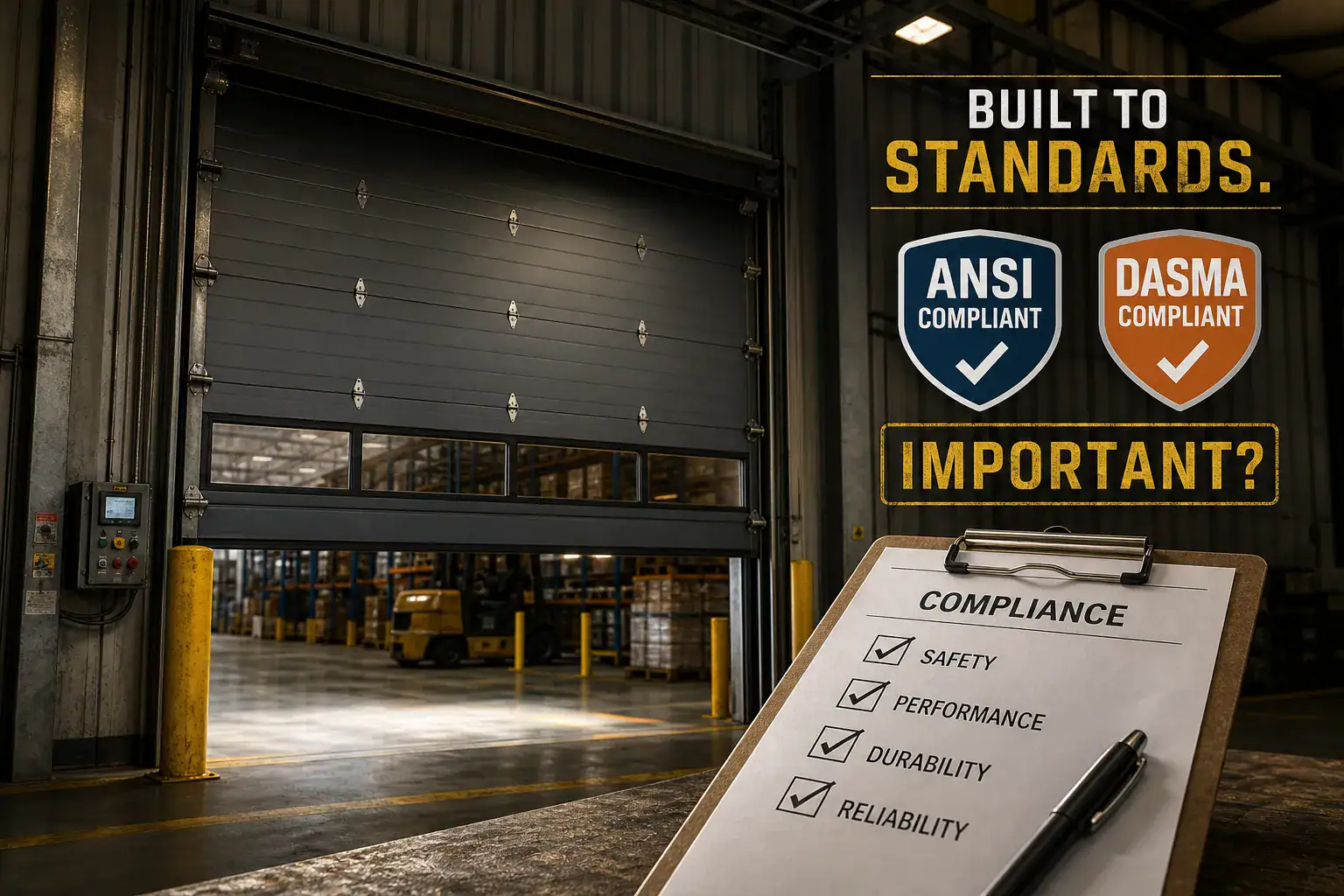
What ANSI/DASMA standards actually govern for industrial doors
The DASMA standards library covers multiple door types, and not every standard applies to every installation. For industrial sectional overhead doors, the three most commonly referenced documents are ANSI/DASMA 102, ANSI/DASMA 108, and ANSI/DASMA 109. ANSI/DASMA 102 sets design specifications for sectional overhead-type doors used in commercial and vehicular-traffic applications. ANSI/DASMA 108 is the structural test method, covering determination of performance under uniform static air pressure difference for both sectional and rolling doors. ANSI/DASMA 109 governs lifecycle performance, specifically the cycle-count testing that determines rated service life.
Beyond that core trio, DASMA 203 covers non-fire-rated rolling doors for warehouse and factory applications, the standard most relevant for heavy industrial rolling steel installations. DASMA 403 governs high-speed doors and grilles, a separate category with its own performance requirements. In hurricane-zone projects, ANSI/DASMA 115 becomes critical: it sets the test method for missile impact and cyclic wind pressure, the combination of loads that defines windborne-debris performance under Florida Building Code and similar state provisions.
UL 325 sits in a distinct layer. ANSI/DASMA standards govern the door assembly itself: its design, structural performance, and lifecycle behavior. UL 325 governs the door operator and entrapment protection system. A powered industrial door on a loading bay typically needs both: a DASMA-conforming door and a UL 325-listed operator. OSHA references UL 325 acceptance pathways for workplace equipment, which makes the DASMA-plus-UL 325 combination the de facto compliance pair for most US industrial facilities with powered door systems.
Do industrial doors need to be ANSI/DASMA compliant? Voluntary vs. mandatory explained
ANSI/DASMA standards are developed through industry consensus and published as voluntary standards. DASMA states this plainly in its own documentation: conformance with its standards is voluntary because the standards themselves are voluntary. No federal regulation mandates ANSI/DASMA compliance on industrial doors as a standalone legal obligation. This is consistent with the broader US policy framework, which favors voluntary consensus standards over government-unique requirements precisely because it allows industry expertise to drive technical content.
That default position changes when three specific triggers are present. First, when a building code adopts a standard by reference, conformance becomes a condition of permit approval. Second, when a project specification or contract explicitly requires ANSI/DASMA conformance, it becomes a contractual obligation enforceable between the parties regardless of what the code says. Third, when an insurer or lender ties coverage conditions to code-compliant installations, noncompliance creates a direct financial exposure for the facility owner. In each case, the standard itself has not changed its legal character, the code, contract, or policy that references it is what creates the binding obligation.
This distinction defines where the risk actually lives. The question is not whether ANSI/DASMA is “federal law.” The question is whether your specific project triggers one of these three mechanisms, and in US commercial and industrial door installations, at least one of them frequently does. In practice, on most commercial projects, all three triggers are present simultaneously.
How US building codes make ANSI/DASMA compliance a practical requirement
The International Building Code (IBC) Section 1709.5.2.1 requires garage doors and rolling doors to be tested in accordance with ASTM E330 or ANSI/DASMA 108, and to meet the pass/fail criteria of ANSI/DASMA 108. Both the 2021 and 2024 editions include a permanent labeling requirement: the door must carry a label identifying the design pressure rating, the applicable test standard, and the installation drawing reference. This labeling requirement is a common compliance trigger in everyday permit submissions and is frequently the detail that catches imported doors lacking proper documentation.
Most US states adopt the IBC with local amendments, which means IBC provisions set the practical baseline for commercial and industrial installations nationwide. Florida’s Building Code and its High Velocity Hurricane Zone provisions go further, explicitly requiring structural testing to TAS 202 (equivalent to ANSI/DASMA 108 for HVHZ applications) and windborne-debris testing aligned with ANSI/DASMA 115. The Authority Having Jurisdiction in Florida will require test evidence as part of the product approval submittal, it is not a best-practice recommendation. Texas Gulf Coast, Louisiana, and coastal Carolina jurisdictions follow similar logic under their state adoptions of wind-load provisions.
The application category also shifts the compliance map. A sectional door on a cold-storage loading dock faces different code triggers than a rolling steel door on a manufacturing plant floor. Fire-rated rolling doors trigger a separate compliance path through UL 10B fire testing and UL 1784 smoke testing, which exists alongside DASMA product standards rather than replacing them. On top of model code minimums, architects and structural engineers frequently layer additional requirements in Division 08 project specifications, making the total compliance obligation specific to each project.
How ANSI/DASMA compliance affects building permits and insurance
Building department plan reviewers check for evidence of code-referenced standard compliance before issuing a permit, this is especially true for wind-load and structural performance documentation. A complete submittal for an industrial sectional door typically includes certified test reports to ANSI/DASMA 108 for structural performance, ANSI/DASMA 109 for cycle life, manufacturer product data sheets identifying the tested model, installation drawings, and the permanent label specification showing design pressure rating and test standard. Submitting an incomplete package is the single most common reason industrial door permits stall, and the resulting schedule delays far outweigh the cost of assembling correct documentation before the door ever ships.
The insurance exposure is equally direct. Commercial property and builder’s risk policies increasingly tie coverage conditions to code-compliant installations. A door that cannot demonstrate ANSI/DASMA conformance when required by the applicable code creates a coverage gap that surfaces at the worst possible moment, after a wind event or structural failure. Insurers in wind-prone states have used noncompliance to narrow coverage, dispute causation, or deny wind-driven interior damage claims when the evidence shows the door was not installed to the wind-resistance standard the code required. The Texas Windstorm Insurance Association has addressed uncertified doors as an eligibility issue, not simply a claims dispute.
The liability exposure extends beyond the facility owner. The specifier and the contractor both carry risk if an installation cannot be shown to meet the standard referenced by the governing code. In practice, the insurance conversation alone is what motivates most sophisticated facility operators to require manufacturer compliance documentation before issuing any purchase order.
How to verify ANSI/DASMA compliance and what documentation to request
The documentation package you need before site delivery has five core components. First, third-party test reports from an accredited independent laboratory covering ANSI/DASMA 108 for wind load and structural performance, ANSI/DASMA 109 for cycle life, and ANSI/DASMA 115 for projects in hurricane zones. Accredited US laboratories for ANSI/DASMA 108 testing include Underwriters Laboratories, Intertek/ETL Testing Laboratories, and American Test Lab Inc. Second, manufacturer certificates of conformance. Third, product data sheets identifying the specific tested model or series. Fourth, sample permanent labels showing design pressure ratings and the test standard reference. Fifth, for import projects, ISO 9001 registration and relevant product certifications that importers commonly include in the shipment record to support supplier quality documentation.
One critical verification step that many buyers miss: confirm that the test reports cover the specific door series and configuration being specified, not just a representative model from a different product line.
Consider a common mismatch scenario: a test report on a 10-foot-wide standard sectional door does not automatically validate a 40-foot-wide high-wind-load variant. The test evidence needs to match the actual door going into the project, down to the specific model, width, height, and wind-load class.
Sourcing from a pre-certified manufacturer eliminates the need to commission independent testing on the buyer’s side, which can take weeks and add cost to a project that is already on a tight schedule. ABX Doors is built around this compliance-first approach, offering heavy-duty industrial sectional doors and loading dock systems with manufacturer documentation designed to support permit submissions, specification acceptance, and insurance underwriting. The package typically includes CAD drawings, certified test reports, and specification sheets that architects and engineers can incorporate into permit submittals, along with motor certifications relevant to UL-aligned operator documentation that US facility projects increasingly require in the same package. For US distributors and facility developers sourcing at scale, working with a compliance-ready manufacturer reduces friction at customs clearance, permit review, and insurance underwriting.
The bottom line: do industrial doors need to be ANSI/DASMA compliant in the United States?
ANSI/DASMA compliance for industrial doors is not a blanket federal mandate. What it is, in practice, is a condition of approval for the large majority of US commercial and industrial door installations. The IBC, state-adopted codes, the Florida Building Code, and project specifications all pull ANSI/DASMA standards into binding territory through the same mechanism: adoption by reference. When the code requires testing to ANSI/DASMA 108 and your project requires a building permit, compliance is no longer a choice.
Three triggers convert a voluntary standard into a practical obligation. Code adoption is the first, most US commercial projects fall under an IBC-based code that references ANSI/DASMA 108 directly. Project specifications are the second, architects and engineers routinely call out DASMA conformance in Division 08 documents. Insurance and lender requirements are the third, and on most US commercial projects, all three are present at once. The documentation quality connects directly to your project timeline: your permit approval, specification acceptance, and insurance coverage all depend on paperwork you need in hand before the door leaves the factory.
If you are specifying or sourcing industrial sectional doors for a US facility project, require full ANSI/DASMA test documentation from your manufacturer before committing to a purchase order. Verify that test reports cover your specific door series and configuration. Confirm that the package includes permanent label specifications, installation drawings, and certifications that support both the permit submission and the import documentation process. Contact ABX Doors to discuss compliance documentation for your next project and to learn how a compliance-ready manufacturer can help streamline permitting and specification acceptance for your facility.
CONTACT ABX
Your Direct Source for Industrial Access Solutions
We offer 24/7 support. Feel free to leave us a message — we'll reply within 24 hours.