Insulated warehouse doors: R-value, cost & ROI guide
Insulated warehouse doors are often the single largest contributor to annual energy loss in refrigerated facilities, yet most facility managers don’t trace the problem back to the door spec until energy bills have been stacking up for years. A typical refrigerated warehouse loses thousands of dollars annually through undersized door insulation. The gap between an R-7 panel and an R-17 panel doesn’t just show up as a line on a thermometer, it shows up as compressor runtime, product loss, and HVAC maintenance you didn’t budget for.
This guide walks through insulation materials and their real thermal performance, how PU foam thickness affects cold storage results, which door type wins for conditioned docks, installed cost ranges by opening size, and a procurement checklist you can hand directly to vendors. By the end, you’ll have a clear framework for matching the right spec to your facility, comparing quotes accurately, and avoiding the most common misspecification mistakes.

Insulation materials compared: polystyrene vs. polyurethane foam
The two mainstream insulation types in commercial industrial insulated doors are expanded polystyrene (EPS) and injected polyurethane (PU) foam, and the difference between them is not just a performance number on a spec sheet. EPS panels typically deliver R-6.5 to R-10.25, with installed U-factors around 0.23 to 0.30. These cover most general distribution and ambient-temperature warehouse applications at a lower cost per door.
Polyurethane foam panels consistently outperform polystyrene, with R-values ranging from R-12.9 to R-18.4 and installed U-factors as low as 0.16. PU foam’s closed-cell structure resists moisture infiltration, maintains thermal performance over time, and bonds mechanically to steel skins, which reduces cold bridging at panel seams. That mechanical bond matters in high-cycle environments where panels flex repeatedly.
| Insulation type | Typical R-value | Typical U-factor | Moisture resistance | Best application |
|---|---|---|---|---|
| Polystyrene (EPS) | R-6.5 to R-10.25 | 0.23 to 0.30 | Moderate | Ambient distribution, light industrial |
| Polyurethane (PU) | R-12.9 to R-18.4 | 0.16 to 0.23 | High (closed-cell) | Refrigerated warehouses, cold storage |
| Sandwich panel (steel/PU/steel) | R-12 to R-20+ | 0.16 to 0.20 | High | Cold storage, pharmaceutical cold chain, freezer |
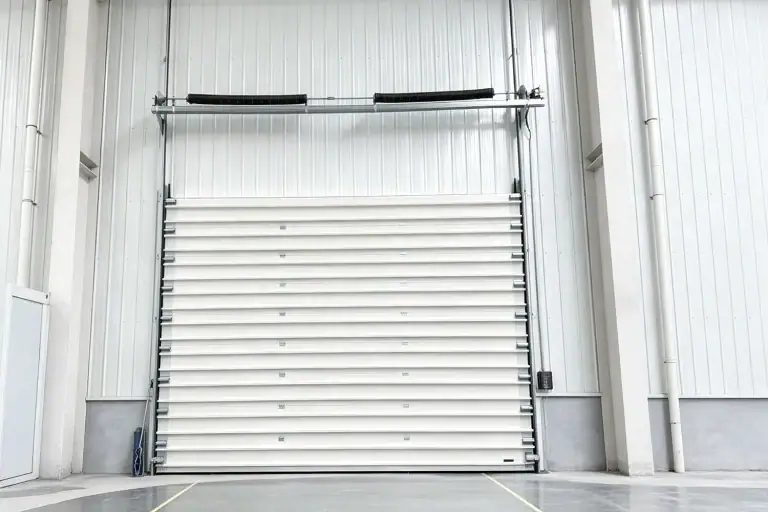
“Sandwich panel” refers to the layered steel/foam/steel construction used in high-performance insulated sectional doors. The steel skins also provide a vapor barrier at both panel faces, which reduces condensation risk on the cold side, a meaningful advantage in freezer applications where moisture infiltration accelerates foam degradation. At scale, these panels reach equivalent or higher performance than standard PU doors, and they’re the construction method used by serious industrial door manufacturers targeting temperature-controlled facilities.
PU foam thickness and cold storage performance: why panel depth matters most
The relationship between PU foam panel thickness and thermal resistance is direct and measurable. A 40mm PU panel typically delivers around R-10 to R-12 at center-of-panel. A 60mm panel reaches R-14 to R-16, and an 80mm panel can approach or exceed R-17, though exact values depend on foam thermal conductivity, density, and closed-cell quality. Note that installed door U-factors will be somewhat lower than center-of-panel figures once frames, joints, and seals are factored in. The jump from 40mm to 80mm is not incremental; it’s the difference between a door that maintains a 35°F cooler and one that holds a -20°F freezer without condensation or thermal creep at the panel face.
Most spec sheets focus on thickness and skip the density variable, which is a mistake. Low-density PU foam can lose R-value over time as thermal cycling stresses the cellular structure. For cold storage and pharmaceutical cold chain applications, high foam density combined with a high closed-cell fraction delivers better long-term performance, though it’s worth noting that aged R-value retention also depends on facer permeability, blowing-agent retention, and manufacturing quality control. When evaluating vendors, request documented aged R-value test results and vapor permeability data alongside nominal density figures.
ABX Doors’ industrial sectional door panels use high-density PU foam across 40, 80mm thickness options, with closed-cell rates exceeding 95% and installed U-factors in the 0.16, 0.20 W/m²·K range consistent with tested high-performance thermal warehouse doors. That’s not a brochure number, it’s the spec that actually delivers a measurable reduction in monthly compressor runtime in temperature-controlled facilities.
In freezer warehouse doors specifically, moisture infiltration through open-cell foam degrades thermal performance over time. High closed-cell PU resists condensation from the inside and handles temperature-driven moisture cycling on the cold face without long-term R-value loss. The rate of degradation depends on facer permeability, HVAC humidity levels, and thermal cycling frequency, all of which vary by facility. When writing your RFQ, require closed-cell rate as a documented specification and ask for test data on aged thermal performance, not just a nominal R-value figure.
Matching R-value to your warehouse climate and application type
For ambient-temperature warehouses in mild climates (ASHRAE Climate Zones 1, 3), thermal warehouse doors in the R-6.5 to R-10 range are typically sufficient to prevent condensation and reduce HVAC load without over-specifying. Standard polystyrene panels or entry-level PU panels cover this application at the lowest installed cost per opening.
Refrigerated facilities storing product at 35, 55°F need insulated sectional doors in the R-13 to R-17 range to maintain stable internal temperatures without excessive compressor runtime. A 60, 80mm PU panel with a tested installed U-factor in the 0.16, 0.23 W/m²·K range is the practical specification target for these applications. Climate Zones 4, 6, which cover the upper Midwest, Great Plains, and Northeast, may require the higher end of this range due to the temperature differential across the door face during winter months.
At sub-zero temperatures, every point of R-value directly reduces compressor load and the risk of frost-lock at the door threshold. For freezer warehouse doors, specify 80mm high-density PU panels, a high closed-cell fraction, and an inflatable dock seal or compression seal system to eliminate the air gap at the dock face. Per ASHRAE/IECC guidance, the minimum target for the full refrigerated cooler assembly is R-25; for freezers, it’s R-32. (Consult the specific ASHRAE 90.1 table or IECC section applicable to your jurisdiction for prescriptive requirements, as these figures apply to the whole assembly rather than the door panel alone.) The door panel is one component of that assembly, and perimeter sealing is the other. A high-R panel with a leaking seal doesn’t solve the problem.
Insulated sectional doors vs. insulated roll-up doors for loading docks
Insulated sectional doors consistently outperform insulated roll-up doors in steady-state thermal resistance. Their panel construction creates a continuous thermal barrier with minimal cold bridging at joints. Published comparisons show sectional doors reaching R-22+ in high-performance configurations, while roll-up doors top out around R-8 even in premium models. For any conditioned or temperature-controlled warehouse, sectional is the stronger thermal choice.
Insulated roll-up doors close one real gap: cycle speed. A faster-opening roll-up door reduces the time a dock opening is exposed during truck loading, which can improve real-world energy performance at very high-cycle docks even if the closed-door insulation value is lower. For docks cycling 50, 100 times per day in ambient-temperature facilities, this trade-off is worth evaluating. For cold storage, it rarely justifies the thermal performance difference.
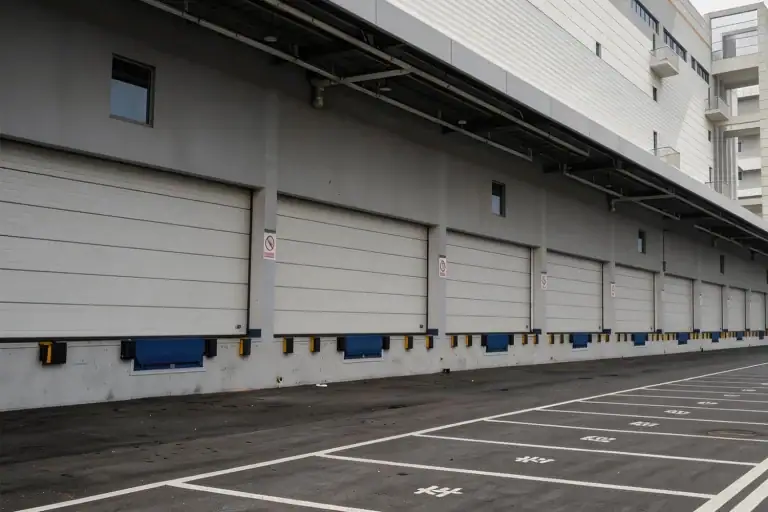
On total cost of ownership, energy efficient loading dock doors in a sectional configuration run higher upfront ($3,500 to $7,500+ for 12×12 openings) but typically deliver lower HVAC costs over a 10, 15 year lifecycle in conditioned facilities. Their mechanical components, tracks, torsion springs, and rollers, are well-standardized and widely serviceable, with industrial-grade configurations commonly rated for 30,000+ cycles per vendor-documented lifecycle testing. Request a vendor’s cycle-life certificate and relevant DASMA test data when comparing options. Roll-up doors are mechanically simpler, but their slatted construction degrades sealing performance over time as compression sets in the joints.
What insulated warehouse doors actually cost and what the ROI looks like
Cost by opening size
For standard insulated sectional steel doors, here are the practical installed cost ranges for warehouse buyers in 2026:
- 10×10 opening, R-12: $2,200 to $4,500 installed
- 10×10 opening, R-18+: $3,500 to $6,500 installed
- 12×12 opening, insulated sectional: $3,800 to $7,500 installed
- 20×20 opening: $10,800 to $22,500 installed
- 24×24 opening: $15,500 to $32,000 installed
Labor adds $800 to $1,800 per door and includes spring tensioning, track alignment, and operator commissioning. Larger openings scale steeply, both in material cost and in installation complexity, so projects with 20+ openings benefit significantly from sourcing direct from an OEM manufacturer rather than through a domestic distributor markup chain.
Payback calculation and ROI
The clearest ROI case for upgrading to higher-R insulated sectional doors is in cold storage. The energy cost differential between an R-7 and an R-17 door can pay back the upgrade in roughly 1 to 3 years in typical refrigerated facilities, depending on door count, local utility rates, cycle frequency, and climate zone. Payback periods as short as 18, 24 months are common when the upgrade replaces a single-skin or low-density panel on a high-cycle dock, though actual savings depend heavily on leakage conditions and operating hours. For ambient-temperature distribution centers, the payback window is longer but still supported by reduced HVAC load and lower dock infiltration losses across the building envelope.
On federal incentives: Section 179D (the commercial building energy-efficiency deduction) is the most likely federal benefit for a warehouse insulation upgrade project that includes insulated commercial doors as part of a qualifying envelope retrofit. The critical 2026 constraint is that Section 179D does not apply to property whose construction begins after June 30, 2026, so timing matters for any project still in the planning phase. State and utility rebates vary by ZIP code; the ENERGY STAR Rebate Finder and DOE incentive databases are the practical starting points for your territory. The residential 25C exterior door credit does not apply to commercial warehouse applications.
Procurement checklist: specs to nail before you request quotes
Requiring a standardized spec sheet from every vendor eliminates apples-to-oranges comparisons. Quotes that use different insulation types, densities, or test methods are nearly impossible to evaluate side by side. Before you issue any RFQ, require vendors to provide written documentation on each of the following:
- Panel thickness in mm
- Foam type and density (kg/m³) with documented aged R-value test data for cold storage applications
- Closed-cell rate (%) with supporting test documentation, a high closed-cell fraction is especially important for freezer applications
- R-value or U-factor as installed door, not center-of-panel only
- Wind load rating (N/m²) with reinforcement option specified
- Spring cycle life rating with vendor-documented test results (30,000+ cycles is a common industrial target)
- Maximum door opening width and height capacity
- Available sealing options for dock faces (inflatable, compression, sponge)
Certification standards to request
For U.S. facility approvals, ANSI/DASMA compliance is the critical certification standard. DASMA 102 covers construction, DASMA 108 covers wind load performance, and DASMA 109 covers lifecycle and spring performance. These certifications are commonly requested by building permit reviewers in wind-exposed states like Florida, Texas, and across the Gulf Coast, though permitting requirements vary by jurisdiction, so verify specific submittal requirements with your local code official. ABX Doors is designed to meet ANSI/DASMA 102, 108, and 109 requirements for the U.S. market, alongside CE, EAC, and ISO 9001/14001/45001 certifications that streamline import documentation for distributors and dealers.
Treat documentation availability as a vendor quality signal. Vendors who provide downloadable CAD drawings, U-factor test reports, and TUV motor certifications upfront are generally better positioned to deliver on spec. If a vendor can’t produce those documents before the order, treat it as a risk indicator that warrants further due diligence before committing. ABX Doors maintains a VIP resource center for architects and engineers with that documentation available before the RFQ stage, which cuts project approval timelines for U.S. buyers navigating local building codes.
The bottom line on specifying insulated warehouse doors
Specifying insulated warehouse doors correctly reduces HVAC runtime, protects product quality, and cuts maintenance costs across a facility’s service life. The right spec comes down to your internal temperature requirement, your climate zone, and your daily cycle count. PU foam panels in the 40, 80mm range with high density and high closed-cell rates deliver the best cold storage thermal performance available in insulated overhead door construction. Sectional doors outperform roll-up for conditioned facilities in almost every category except cycle speed and upfront cost.
Use the cost ranges and procurement checklist in this guide to build a spec sheet before you talk to vendors. It will save time, eliminate misquotes, and give you a real basis for comparing proposals. The energy savings from properly specified insulated warehouse doors compound over a decade of operation, and for cold storage facilities, the payback period on a proper 80mm high-density PU upgrade is typically measured in months, not years.
If you’re sourcing for a multi-bay facility or need OEM/ODM pricing on certified industrial sectional doors with full ANSI/DASMA documentation, contact ABX Doors to request a technical spec sheet and project quote. Bring your opening dimensions, temperature setpoints, and daily cycle estimate, and you’ll get a spec that actually fits the application.
CONTACT ABX
Your Direct Source for Industrial Access Solutions
We offer 24/7 support. Feel free to leave us a message — we'll reply within 24 hours.