How Sectional Doors Are Tested for Hurricane Resistance
Picture a Category 4 storm making landfall on the Gulf Coast. Inside a distribution center, millions of dollars of inventory sit behind loading bay doors that were never properly tested for the wind loads their location demanded. When those doors fail, the building envelope fails with them, and the damage that follows isn’t covered by a “design pressure” claim printed on a spec sheet that nobody verified. That failure was preventable.
How are sectional doors tested for hurricane resistance? The answer runs through a specific sequence that most facility developers and engineers don’t fully understand, partly because the standards framework is more fragmented than it appears. This article walks through each phase of that sequence: which standards actually govern the process, what the pressure ratings on a product label mean, and how to confirm a door is genuinely certified before you specify it for a Florida or Gulf Coast project.
Understanding how sectional doors are tested for hurricane resistance helps you evaluate what you’re actually buying, and whether the certification documentation behind it will hold up when building officials review permit submissions.

Why sectional doors follow different standards than windows and curtain walls
The most common misconception in this space is assuming that ASTM E1886 and ASTM E1996 govern sectional door hurricane testing. They don’t. Both standards explicitly exclude exterior garage doors and rolling doors from their scope. Sectional doors operate under a separate standards framework built for their specific loading conditions, and conflating the two leads to specification errors on regulated projects.
The ANSI/DASMA 108 standard and what it actually tests
ANSI/DASMA 108 is the governing wind load test method for sectional doors in the United States. It measures structural performance under positive and negative air pressure applied to the door assembly, along with deflection limits and residual deformation after loading. Related DASMA standards, ANSI/DASMA 102 and 109, address construction requirements and lifecycle performance, respectively, forming a broader framework that supports compliant product design, wind resistance, and operational durability.
Where TAS standards enter the picture for Florida approvals
TAS 201, TAS 202, and TAS 203 are Florida-specific test methods used within the Miami-Dade and Florida Product Approval pathway. They are not replacements for DASMA standards. Instead, they are additional test layers required for High Velocity Hurricane Zone (HVHZ) approval, which applies to Miami-Dade and Broward Counties. Florida Building Code approval and Miami-Dade NOA (Notice of Acceptance) are approval frameworks, not test standards. A door can hold an NOA number only after satisfying the underlying test requirements these frameworks reference.
ANSI/DASMA 115 for impact-rated sectional doors
ANSI/DASMA 115 is the dedicated standard covering windborne debris impact resistance for sectional doors, filling the gap left by ASTM E1996’s explicit exclusion. It covers missile impact followed by cyclic wind pressure for sectional, rolling, and flexible door assemblies, with the pass criterion centered on whether the door remains unbreached after the full sequence. For HVHZ projects, DASMA 115 requires the use of its Appendix B and C procedures. The distinction between impact-rated and non-impact-rated configurations is a project specification issue: in hurricane zones where windborne debris provisions apply, only the impact-rated classification satisfies code.
How are sectional doors tested for hurricane resistance: the missile impact phase
The missile impact test is the most dramatic phase of hurricane certification. Its purpose is to replicate the damage a structural timber, a piece of roof framing or signage torn free at storm speed, can inflict on a door panel before the wind pressure cycle even begins. A door that collapses under impact alone offers no meaningful hurricane resistance, regardless of its pressure rating.
Large missile vs. small missile and when each applies
Testing runs a two-missile sequence. The large missile is a nominal 9.0 lb 2×4 lumber piece launched at the specimen at approximately 50 ft/s for standard zones and up to 80 ft/s for essential facilities. It simulates structural debris, the kind of heavy timber that becomes a projectile when roof framing or signage tears free in high winds. The small missile test uses 2 g steel balls, ten impacts per location at three prescribed positions, simulating gravel and fine debris common in rooftop environments. Per ASTM E1996 and applicable TAS guidance, small missile testing applies in specific cases depending on exposure conditions and missile level requirements rather than universally across all configurations. Confirm which phases apply based on the project’s exposure category and applicable standard.
Impact locations, target zones, and the pass/fail threshold
Impact locations are prescribed by the standard, typically targeting center, corner, and edge zones with strict placement tolerances. The pass criterion is not a damage score. The assembly must survive the impact without dangerous penetration or catastrophic failure, then remain structurally intact enough to proceed into the cyclic pressure phase. Any breach of the assembly perimeter is a failure, regardless of how localized it appears.
Why impact testing is only the first half of the sequence
Surviving missile impact alone doesn’t constitute certification. After impact, the door must endure the full cyclic pressure loading as a damaged system. A door that holds its shape under the 2×4 strike but loses structural integrity under the subsequent wind pressure cycles fails the complete sequence. This two-phase logic is what makes the certification genuinely representative of storm conditions: a real hurricane delivers both debris impact and sustained, irregular wind pressure.
Wind pressure and cyclic pressure testing in the pressure chamber
Once impact testing is complete, the door assembly moves into the pressure chamber for wind load evaluation. This is where ANSI/DASMA 108 does its primary work, and it’s the number reported as “design pressure” on every certified product label. Understanding how that number is generated helps you interpret what it actually guarantees about field performance.
How the pressure chamber simulates wind loading
The door is mounted in its standard frame and anchor configuration inside a sealed chamber. Positive pressure is applied to the exterior face, simulating wind pushing inward; negative pressure is applied to the interior face, simulating suction. Under ANSI/DASMA 108, the sequence applies a pre-load at 50% of design load held for 10 seconds, steps up to the full design load for another 10 seconds, then reaches the test load at 1.5 times the design load, also held for 10 seconds. Deflection and permanent deformation are recorded at each stage.
Design pressure ratings and what the numbers mean in practice
Design pressure is reported in psf or N/m². A door rated at approximately 9.4 psf (roughly 450 N/m²) handles standard high-wind conditions. Reinforced configurations rated at around 14.6 psf (approximately 700 N/m²) meet elevated structural thresholds suited to extreme wind loading conditions in designated hurricane zones. Critically, the test pressure is set at 1.5 times the rated design pressure, so a certified door has actually been validated at a significantly higher load than its rated value implies. That safety margin is built into the standard, not added informally by manufacturers.
Cyclic pressure loading: simulating storm gust patterns
The cyclic loading sequence simulates the irregular, hammering pressure changes of an actual hurricane rather than a single sustained peak load. The Florida-aligned sequence runs 800 cycles at 40% of test pressure, 200 cycles at 50%, 20 cycles at 65%, and a final single cycle at 100%. This fatigue simulation separates a door designed for steady wind from one that can survive the repeated gust patterns that characterize a real storm event. A door that passes static pressure testing but isn’t subjected to cyclic loading has not been fully evaluated for hurricane zone use.
Water infiltration and air leakage: the third test layer
Structural and impact performance answer whether a door stays in place during a storm. Water infiltration and air leakage testing answer whether the building envelope actually holds after wind peaks. For Florida HVHZ approvals, all three test layers are required, and a door approval that skips this phase isn’t valid for regulated projects in Miami-Dade or Broward Counties.
The standards used and their test logic
ASTM E283 tests air infiltration at 1.57 psf static pressure difference. ASTM E331 tests uniform static water penetration, and ASTM E547 tests cyclic water penetration.
TAS 202 is Florida’s HVHZ sequence, which combines those individual test types into a defined order: air infiltration first, then structural loading, then water intrusion, then a higher structural loading pass. The TAS 202 water test applies static pressure equivalent to at least 15% of the door’s positive design pressure, held for 15 minutes.
Pass/fail thresholds you need to know
Air leakage must not exceed 0.3 cfm/ft² at 1.57 psf under ASTM E283. Water tests under ASTM E331, E547, and TAS 202 require zero water infiltration at the specified test pressure. These are binary pass/fail criteria, not sliding scales. A Florida Product Approval or Miami-Dade NOA document will explicitly state whether the door met each threshold, and any failure in the water or air phase invalidates the HVHZ approval regardless of how well the door performed on pressure testing.
How serious manufacturers validate for hurricane zone requirements
Understanding how sectional doors are tested for hurricane resistance is one thing. Seeing how a manufacturer actually prepares for and completes that sequence reveals the gap between a door that meets minimum code and one engineered for the worst conditions on record. That difference is visible in the certification documentation before a single door leaves the factory.
Third-party certification vs. manufacturer self-declaration
Third-party certification requires an accredited independent laboratory to witness and report on all test phases. Self-declaration is a manufacturer’s own representation of compliance, with no external verification. For Florida Product Approval and Miami-Dade NOA, third-party test documentation is required: there is no self-reporting path for HVHZ projects. Any manufacturer quoting hurricane compliance for HVHZ use without referencing a third-party test report is presenting unverifiable claims.
ABX Doors: certification documentation built for US project approvals
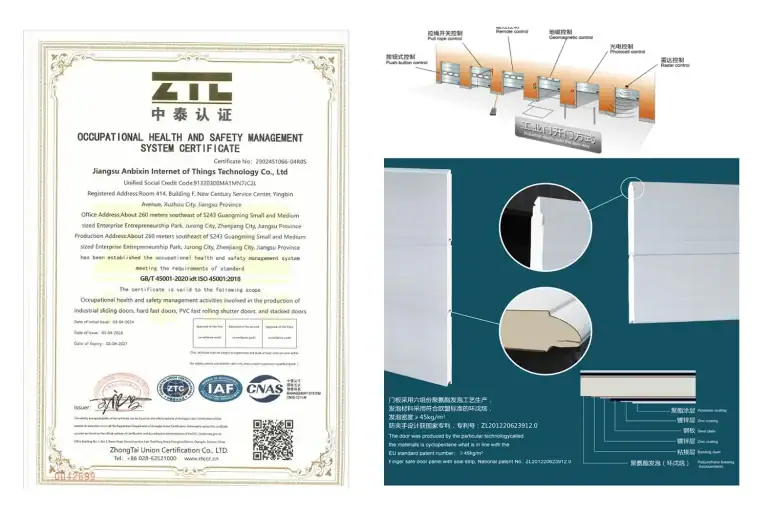
ABX Doors’ industrial sectional doors carry ANSI/DASMA 108 and 109 compliance, with reinforced configurations rated at approximately 700 N/m² (roughly 14.6 psf), a wind load threshold suited to demanding hurricane zone applications along the Florida and Gulf Coast. ABX also holds ANSI/DASMA 102 compliance alongside CE, EAC, and ISO certifications. The full documentation package, including test reports, CAD drawings, motor certifications, and wiring manuals, is available for architects and engineers to use directly in building permit submissions, which reduces approval timelines on projects where third-party-verified specs are required from day one.
What certification documentation should include for project use
A compliant manufacturer should provide the following for any hurricane zone project:
- Third-party test report referencing the specific standard (ANSI/DASMA 108, DASMA 115) and the actual test pressure values
- Florida Product Approval number or Miami-Dade NOA number for HVHZ projects
- Installation instructions that form part of the approved assembly
- Hardware and track specifications tied to the tested configuration, not just the panel alone
The approval covers the entire door system. A certified panel installed with non-tested hardware or track components voids the approval.
How to verify a sectional door’s hurricane rating before you specify it
Certification claims on a spec sheet and actual verified compliance are two different things. The initial verification steps are straightforward when you know where to look, but confirming full compliance on a complex project involves reading labels, cross-referencing approval databases, and reviewing drawings against installation instructions. It’s the only way to confirm that what’s been specified will satisfy building officials and inspectors on regulated projects.
Reading the product label correctly
The permanent door label should show the manufacturer name, model or series designation, positive and negative design pressure values in psf or N/m², and any approval number or test standard reference such as ANSI/DASMA 108. A pressure rating on the label is the key indicator. If the label lists only model information without pressure values, request the third-party test report directly before proceeding. A product that can’t produce a test report with pressure data has no verifiable hurricane rating.
Checking Florida Product Approval and Miami-Dade NOA databases
Use the Florida Building Code online product approval search or Miami-Dade’s product approval directory to look up the approval number from the door label. Confirm that the drawing number, impact/non-impact designation, and installation instructions in the approval record match exactly what’s being installed. Some approvals distinguish impact-rated from non-impact-rated configurations using separate designations, so verify the specific classification. An approval for a non-impact-rated version of a door model does not satisfy windborne debris requirements even if the manufacturer name and model appear in the database.
Deciding between reinforcement and full replacement
If a door carries no label, no traceable approval number, or a design pressure rating below what the site’s wind load calculation requires, reinforcement hardware typically cannot bring it into compliance. Replacement with a fully certified assembly is the only defensible path for hurricane zone permitting. Attempting to supplement an uncertified door with aftermarket bracing does not produce a tested system and won’t satisfy a building official reviewing permit documentation.
What the test sequence adds up to
How are sectional doors tested for hurricane resistance? The answer spans four distinct phases: ANSI/DASMA 108 wind load pressure testing, missile impact evaluation under DASMA 115, cyclic pressure fatigue simulation, and water and air infiltration testing for Florida HVHZ approvals. Each phase answers a different question about real storm performance, and a door that clears all phases under third-party observation is a fundamentally different product from one that meets only minimum structural requirements.
For facility developers, engineers, and distributors sourcing doors for hurricane-prone regions, the certification trail matters as much as the product spec. ABX Doors provides the full documentation package, ANSI/DASMA 108/109 compliance, third-party test reports, and CAD drawings, built specifically for US market project approvals. When the next hurricane season arrives, the right time to verify a door’s rating is well before the forecast.
CONTACT ABX
Your Direct Source for Industrial Access Solutions
We offer 24/7 support. Feel free to leave us a message — we'll reply within 24 hours.