Certifications to Check Before Importing Industrial Doors
Here’s a scenario that plays out more often than it should: a facility owner sources industrial sectional doors overseas, the shipment clears the port without issue, and then the project grinds to a halt because the local building inspector won’t approve the installation without ANSI/DASMA documentation. That single oversight costs weeks of delay and thousands of dollars in rescheduled crews, missed lease commitments, and expedited freight for replacement paperwork. The frustrating part is that it’s entirely avoidable.
When importing industrial doors, knowing what certifications to look for, and which ones actually carry legal weight, is the difference between a project that moves on schedule and one that stalls after the shipment lands. The certification landscape involves multiple overlapping frameworks: US-specific performance standards, European conformity marks, electrical safety listings, and manufacturer quality credentials. Not all of them carry equal weight with customs officials or local building authorities, and knowing the difference between a supporting document and a required one can mean the difference between a smooth import and a costly compliance gap. Manufacturers like ABX Doors, who maintain the full certification stack across US-accepted and internationally recognized frameworks, set the benchmark for what a truly import-ready supplier looks like. This guide breaks it all down so you know exactly what to ask for before your purchase order is signed.

Why Certification Gaps Cause More Than Customs Delays
Most importers focus their compliance energy on getting through US Customs and Border Protection, and that’s understandable. CBP clearance requires correct HTS classification (typically under 7308.30 for steel sectional doors or 7610.10 for aluminum), country-of-origin marking, and a complete entry package including commercial invoice, packing list, bill of lading, and Form 7501. If the shipment includes significant steel or aluminum content, Section 232 documentation may also apply. Getting all of that right is necessary, but it’s only half the battle.
The bigger risk sits on the other side of the port: the Authority Having Jurisdiction, or AHJ. Building inspectors, architects of record, and fire marshals can reject non-compliant door assemblies after installation, triggering costly rework and project restarts. For US facility owners managing logistics hub buildouts or cold storage expansions, a two-week door-related delay can cascade into missed operational deadlines and real revenue loss. There are two separate compliance tracks running in parallel, and most importers prepare for one and get blindsided by the other.
What Certifications to Check When Importing Industrial Doors: CE Marking and European Standards
CE marking confirms that an industrial door meets European Union product safety and performance directives, specifically EN 13241-1 for the door product standard and EN 12453 for powered-door safety in use. These documents are legitimate technical evidence of design quality, safety testing, and conformity assessment, and they’re worth requesting and keeping in your compliance file. That said, CE marking is not equivalent to US certification, and no US building official or customs authority is required to accept it as standalone proof of compliance.
For a CE-certified door entering the US market, the manufacturer’s Declaration of Conformity and test reports function as supporting evidence, not final approval. US code officials need documentation that maps the door’s performance to US standards, specifically ANSI/DASMA, UL listings, or other accepted American frameworks. Importers who assume a CE certificate alone satisfies a US building permit submittal routinely run into AHJ rejections. The practical move is to source from manufacturers who hold both CE certification and US-recognized compliance documentation simultaneously, so neither track is left incomplete.
ANSI/DASMA Standards: The Compliance Framework US Building Officials Enforce
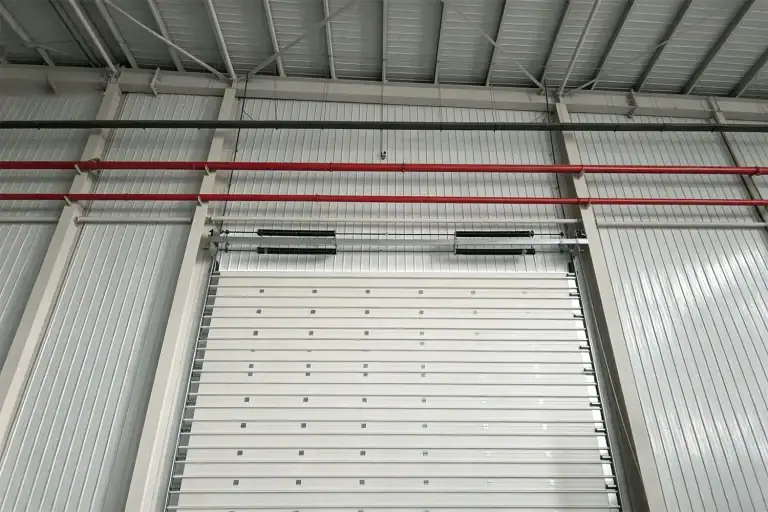
ANSI/DASMA 102 is the core design and safety criteria standard for commercial and industrial sectional doors. It governs component specifications, labeling requirements, and safety performance for doors used at warehouses, loading docks, manufacturing plants, and similar vehicular-access openings. Under DASMA 102, door systems must be designed for a minimum of 10,000 cycles and must not deflect more than 1/120 of the door width when held horizontal. This is the foundational document US building officials reference when reviewing industrial door submittals.
DASMA 108 covers wind-load resistance, and in hurricane-prone states including Florida, Texas, and Gulf Coast jurisdictions, it’s non-negotiable. Wind-load documentation must show that the full door assembly, not just the panel, has been tested at the required design pressure for the project’s exposure category. ABX Doors’ industrial sectional doors are rated to 700N/m² with reinforcing bars, meeting Category 12 typhoon resistance and mapping directly to high-end DASMA 108 requirements. Suppliers who cannot provide DASMA 108 test documentation will fail wind-zone permit reviews without exception.
DASMA 109 addresses lifecycle performance and DASMA 110 covers thermal performance, rounding out the full compliance picture for US industrial door installations. When a manufacturer already holds documentation across all four standards, the permitting process moves significantly faster. Architects and structural engineers can reference the existing compliance file rather than commissioning new testing or field evaluations, which directly compresses construction schedules on large-scale logistics projects with multiple loading bays.
How UL 325 and NRTL Listing Answer What Certifications to Look For on Powered Operators
UL 325 is the primary US safety standard for door, gate, and window operators. It governs entrapment protection, constant-pressure-to-close behavior, and monitoring of safety devices such as photo eyes and sensing edges. When powered operators are part of an industrial door installation, US inspectors and AHJs typically expect UL 325 compliance and, more specifically, an NRTL listing on the operator unit. An NRTL mark from a lab recognized under OSHA’s program signals that the electrical components have been independently tested to a US-accepted standard.
A CE-marked motor or control panel satisfies EU electrical safety requirements, but it does not carry automatic acceptance by US inspectors. OSHA’s NRTL program governs what US authorities accept for electrical safety certification, and CE is not part of that program. To verify an NRTL listing, check for the following:
- The NRTL mark on the product label
- A Certificate of Compliance or Authorization to Mark from the manufacturer
- Confirmation that the certifying lab appears on OSHA’s current recognized list
- An active listing in the NRTL’s online product directory for the specific model number
For imported industrial doors with powered operators, request either an NRTL listing certificate or, at minimum, a TUV-certified motor with documentation showing the operator meets UL 325 performance requirements. Verify this before the order is placed, not after the shipment arrives. Final acceptance still sits with the AHJ, but a valid NRTL listing removes the most common objection inspectors raise on imported operator systems.
ISO and EAC Certifications: Manufacturer Credibility Signals That Reduce Friction
ISO 9001 certification confirms that the manufacturer operates under a documented, audited quality management system. For industrial doors, this matters because it means the production unit shipped to your facility was manufactured under controlled, repeatable processes, not just the test sample used to obtain the product certification. ISO 14001 covers environmental management and ISO 45001 covers occupational health and safety. Together, these three certifications signal a manufacturer running a serious operation rather than a commodity supplier with inconsistent process controls.
EAC certification covers compliance with the technical regulations of the Eurasian Economic Union, and while it’s not a US-required certification, its presence tells importers something meaningful. EAC certification typically requires accredited third-party testing, an on-site manufacturing audit for serial production, and ongoing annual surveillance after issuance. A supplier who holds CE, EAC, and ISO certifications simultaneously has demonstrated a systematic approach to compliance across multiple rigorous frameworks. That track record is a strong signal that their documentation will hold up under US customs and AHJ scrutiny.
The Practical Document Checklist: What to Request from Your Supplier
Before releasing any purchase order for an industrial door import, collect this complete document set from your supplier. Each document should show the issuing body’s name, the specific standard covered, the date of issue, and an expiration or review date. Cross-check model numbers and assembly configurations across all documents to confirm that the tested product matches exactly what you’re buying.
- CE Declaration of Conformity with reference to EN 13241-1 and EN 12453
- ANSI/DASMA 102, 108, 109, and 110 compliance certificates or test reports
- UL 325 NRTL listing certificate for powered operators (or TUV motor certification with UL 325 performance mapping)
- ISO 9001, 14001, and 45001 certificates with current validity dates
- Factory Production Control audit records demonstrating production consistency
- Test reports identifying the exact assembly tested, including panel, frame, hardware, and seals
- Country-of-origin marking confirmation and HTS classification support
- RoHS compliance documentation for electrical components, where applicable
- Installation and operation manuals in English
One of the persistent frustrations in industrial door sourcing is chasing fragmented documentation from suppliers who treat certification as an afterthought. ABX Doors holds CE, EAC, and ISO 9001, 14001, and 45001 certifications. On the US standards side, they cover ANSI/DASMA 102, 105, 108, 109, and 110, the full checklist. Their VIP resource center provides architects, engineers, and facility developers with downloadable CAD drawings, TUV and CE motor certifications, technical specification sheets, and wiring manuals on demand. For US buyers managing permit submissions and customs clearance simultaneously, that documentation infrastructure compresses approval timelines and eliminates the back-and-forth that typically stalls imported door projects.
What Certifications Should You Look for When Importing Industrial Doors? The Standard Worth Holding Every Supplier To
The certification stack matters because it determines whether your project clears permitting or stalls, not once, but at multiple checkpoints along the way. The practical standard for US facility owners is clear: your supplier needs ANSI/DASMA compliance for building code acceptance, UL 325 or NRTL coverage for powered operators, CE documentation as technical evidence, and ISO certifications as proof of manufacturing discipline.
Request the full document set before your purchase order is signed, and verify that the certified assembly matches the specific product you’re receiving. Confirm that test reports cover the complete assembly, including frame, hardware, seals, and glazing, not just the door panel. Check that all document reference numbers, certificate numbers, and validity dates are internally consistent and current. Expired, altered, or non-traceable documentation is a red flag that should stop any order before it starts.
When you source from a manufacturer who already carries the complete certification stack and can deliver the paperwork on demand, you eliminate the single biggest risk in industrial door importing: arriving at a compliance gap when there’s no time left to fix it. That level of documentation readiness is the baseline to require from every supplier you evaluate, and the clearest way to distinguish a supplier who is genuinely import-ready from one who is not.
Frequently Asked Questions
What certifications should I look for when importing industrial doors into the US?
At minimum, look for ANSI/DASMA 102 (and 108 in wind-zone jurisdictions), UL 325 or an NRTL listing for powered operators, CE marking with a Declaration of Conformity, and ISO 9001 from the manufacturer. This combination satisfies both US building code requirements and quality verification needs. Additional certifications such as DASMA 109, DASMA 110, ISO 14001, ISO 45001, and EAC further reduce friction at customs and with local AHJs.
Is CE marking enough to clear US customs and pass building inspections?
No. CE marking satisfies EU directives but does not substitute for US-required certifications. US building officials and AHJs require documentation tied to American standards, primarily ANSI/DASMA and UL 325. CE documents belong in your compliance file as supporting evidence, not as primary approval.
What is an NRTL listing and why does it matter for imported door operators?
An NRTL (Nationally Recognized Testing Laboratory) listing means the electrical component has been tested and certified by an independent lab approved under OSHA’s recognition program. US inspectors require NRTL listings for powered door operators because CE-marked motors are not automatically accepted under US electrical safety rules. Verify the listing is active in the lab’s online directory before placing your order.
CONTACT ABX
Your Direct Source for Industrial Access Solutions
We offer 24/7 support. Feel free to leave us a message — we'll reply within 24 hours.