Repair vs. Replace: What is the Average Cost to Replace a Dock?
When aging warehouse infrastructure begins to fail, facility managers face a critical financial decision: continue funding reactive repairs or invest in a complete system upgrade. Calculating the average cost to replace a dock leveler is essential for capital expenditure planning, but this figure must be weighed against the hidden costs of retaining obsolete equipment. For high-throughput logistics hubs, a malfunctioning loading dock system is not merely a maintenance nuisance; it is a severe operational bottleneck that disrupts supply chain timelines and introduces significant safety liabilities.
The dilemma of “repair versus replace” hinges on identifying irreversible structural fatigue. While hydraulic seals can be replaced and mechanical springs can be re-tensioned, a warped deck plate or cracked lip hinge indicates that the equipment has reached the end of its safe operational lifecycle. Continuing to operate structurally compromised levelers violates OSHA guidelines and ANSI/DASMA standards, exposing the facility to substantial fines and worker injury claims. Furthermore, older mechanical units lack the fail-safe mechanisms and IoT connectivity required by modern, automated material handling environments.
This article provides a framework for evaluating the lifecycle of your loading dock equipment. We will detail the specific signs of structural failure that mandate a replacement and break down the comprehensive costs associated with removing old units and installing modern hydraulic systems. By transitioning to advanced equipment featuring double 5-degree arch lips and smart IoT control boxes, facilities can eliminate chronic repair bills, improve forklift transition safety, and achieve a rapid return on investment. Understanding these dynamics empowers procurement teams to justify necessary facility upgrades.

Identifying Critical Structural Fatigue
Warped Lips and Cracked Welds
The most definitive sign that a dock leveler requires replacement is structural deformation. Inspect the lip and the rear hinge assembly. If the lip is permanently bent or if there are visible cracks in the structural welds, the unit is no longer safe to operate under its rated capacity.
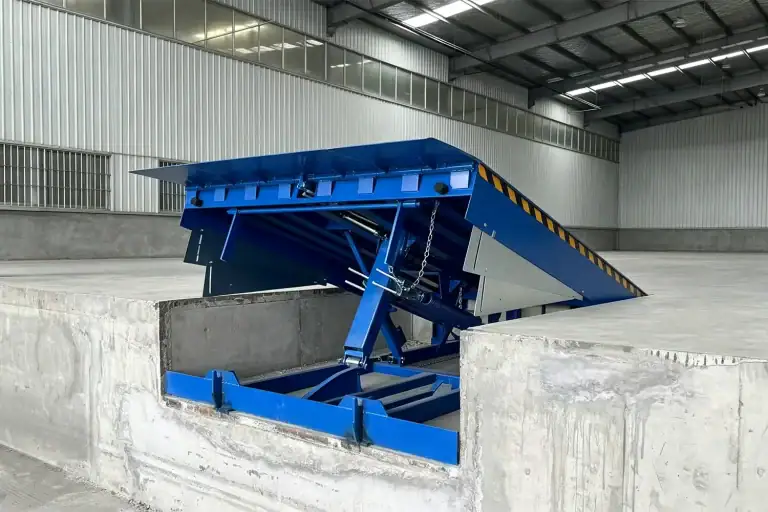
Modern replacements solve these legacy issues through advanced engineering. For instance, upgrading to a unit with a closed tubular hinge design and a double 5-degree arch lip ensures long-term structural integrity and provides a perfectly smooth transition for forklifts, eliminating the jarring impacts that cause metal fatigue.
The Hidden Costs of Frequent Repairs
When evaluating replacement costs, facility managers must calculate the true cost of ongoing repairs. This includes not only the price of replacement parts and emergency technician labor rates but also the cost of facility downtime. A single out-of-service bay can delay shipping schedules and incur demurrage charges.
If the annual maintenance cost of a dock leveler exceeds 15% to 20% of the cost of a new unit, replacement is financially prudent. Transitioning from a high-maintenance mechanical unit to a low-maintenance hydraulic system yields immediate operational savings.
Calculating the Replacement Investment
The total cost to replace a dock leveler encompasses several phases. First is the removal and disposal of the existing unit. Next, the concrete pit must be cleaned, inspected, and potentially modified (re-squared or repaired) to accept the new equipment.
Finally, the cost of the new hydraulic unit and its installation must be factored in. While this represents a significant capital expenditure, partnering with a direct OEM manufacturer can optimize procurement costs. Furthermore, new units equipped with “one-door-one-code” QR reporting systems drastically reduce future maintenance overhead by streamlining the diagnostic and repair process.
CONTACT ABX
Your Direct Source for Industrial Access Solutions
We offer 24/7 support. Feel free to leave us a message — we'll reply within 24 hours.