What Is the Difference Between Hydraulic and Mechanical Dock Levelers?
For warehouse operators and logistics facility managers, the loading dock is the heartbeat of the supply chain. When upgrading dock equipment, the most common dilemma is choosing between hydraulic and mechanical dock levelers. While both serve the same fundamental purpose—bridging the gap between the warehouse floor and the truck trailer—their operational mechanisms, maintenance requirements, and long-term reliability are vastly different.
1. Operational Mechanism: Springs vs. Cylinders
The primary difference lies in how the leveler is powered and operated.
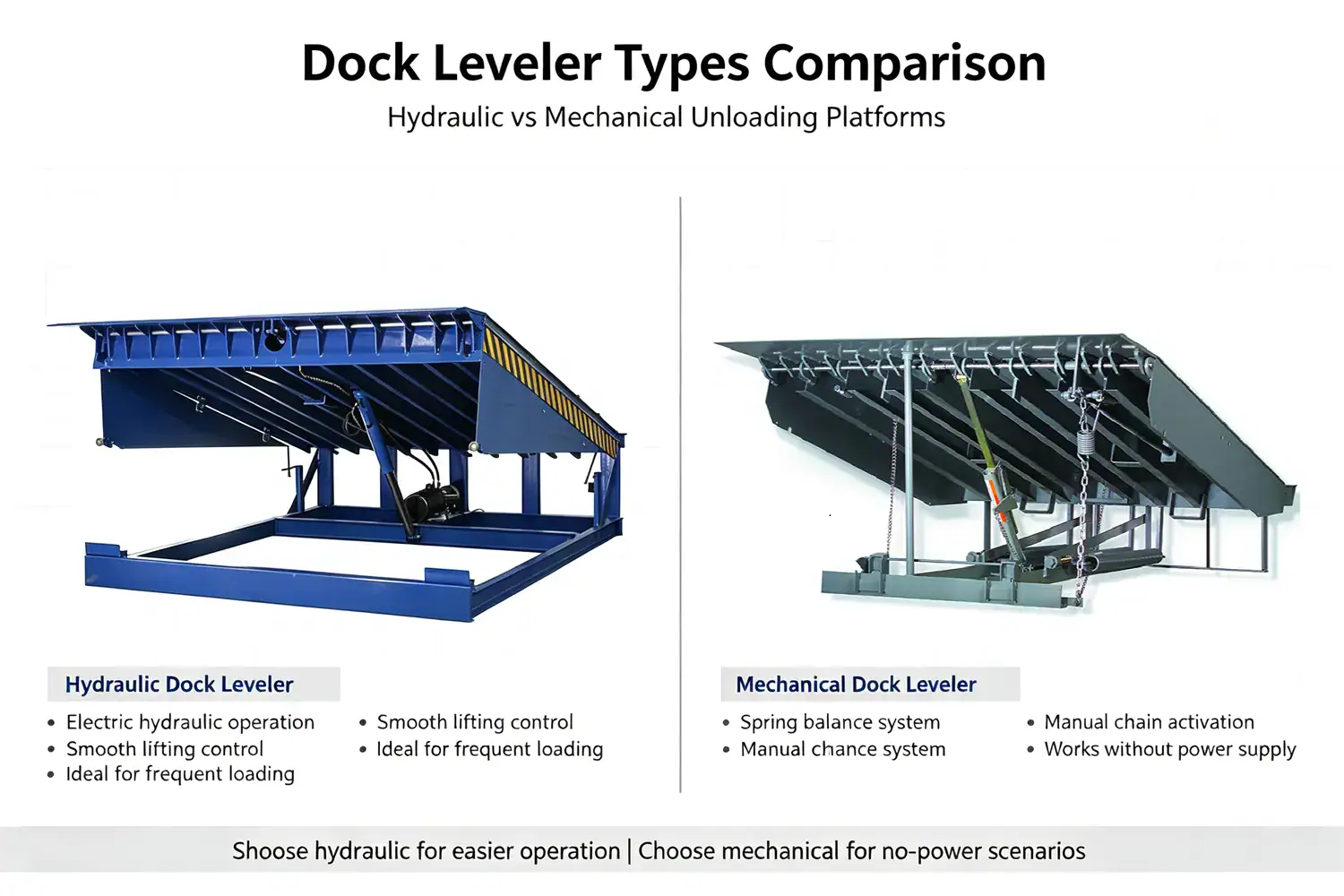
- Mechanical Dock Levelers: These are manually operated. They rely on a complex system of heavy-duty extension springs, lip latches, and a pull-chain. The operator pulls the chain, and the springs force the deck upward. The operator then walks on the deck to force it down onto the truck bed.
- Hydraulic Dock Levelers: These are fully automated. Powered by an electric motor and hydraulic pump, the operator simply presses a button. Hydraulic cylinders smoothly raise the deck and extend the lip, then gently lower it onto the trailer.
2. Maintenance and Total Cost of Ownership (TCO)
While mechanical levelers have a lower initial purchase price, their Total Cost of Ownership (TCO) is significantly higher. The springs in mechanical units are under constant tension and are highly susceptible to metal fatigue. They require frequent lubrication, tension adjustments, and eventual replacement—leading to costly dock downtime.
Hydraulic levelers, conversely, have far fewer moving parts. However, traditional hydraulic systems often suffer from oil leaks. ABX Doors solves this with our H-1000 Series. We utilize an advanced inverted hydraulic cylinder design. By inverting the cylinder, we prevent debris from accumulating on the seals, effectively eliminating the risk of oil leaks and reducing maintenance to near zero.
3. Safety and Ergonomics
Mechanical levelers require physical exertion, increasing the risk of operator injury (e.g., back strain from ‘walking down’ the deck). Furthermore, if a truck departs prematurely, mechanical safety legs can cause severe structural damage to the leveler. Hydraulic levelers offer push-button ergonomics and feature built-in hydraulic velocity fuses that instantly lock the deck in place if a truck pulls away unexpectedly, preventing catastrophic forklift falls.
Upgrade to Advanced Hydraulic Systems
Stop losing money on mechanical maintenance and dock downtime, and discover how our inverted cylinder technology can optimize your loading dock operations. Contact our engineering team for a custom facility assessment.
CONTACT ABX
Your Direct Source for Industrial Access Solutions
We offer 24/7 support. Feel free to leave us a message — we'll reply within 24 hours.