How Many Cycles Can Industrial Sectional Doors Handle Daily?
How many cycles per day can industrial sectional doors handle, and what happens when you get that number wrong? Picture a three-shift distribution center running 20 loading bays, each door cycling open and closed over 80 times a day. That’s 1,600 door movements every 24 hours across the building. Now picture the facility manager who spec’d those doors on size and price, not cycle capacity. Six months in, the springs start failing. Doors go down. Docks go idle. Unplanned downtime in a distribution center doesn’t just cost a repair bill. It costs throughput, contracts, and credibility.
Cycle-per-day capacity is the spec that determines whether an industrial sectional door is an asset or a maintenance liability. It’s the number that predicts real service life, drives your maintenance schedule, and defines how long your warranty actually lasts. ABX Doors designs industrial sectional doors around this spec, targeting the cycle demands of high-throughput warehouse operations and large-scale logistics facilities. This article gives you what you need to get the spec right: a clear breakdown of duty class ratings, the components that determine real-world cycle performance, and a maintenance schedule tied to your actual daily usage.
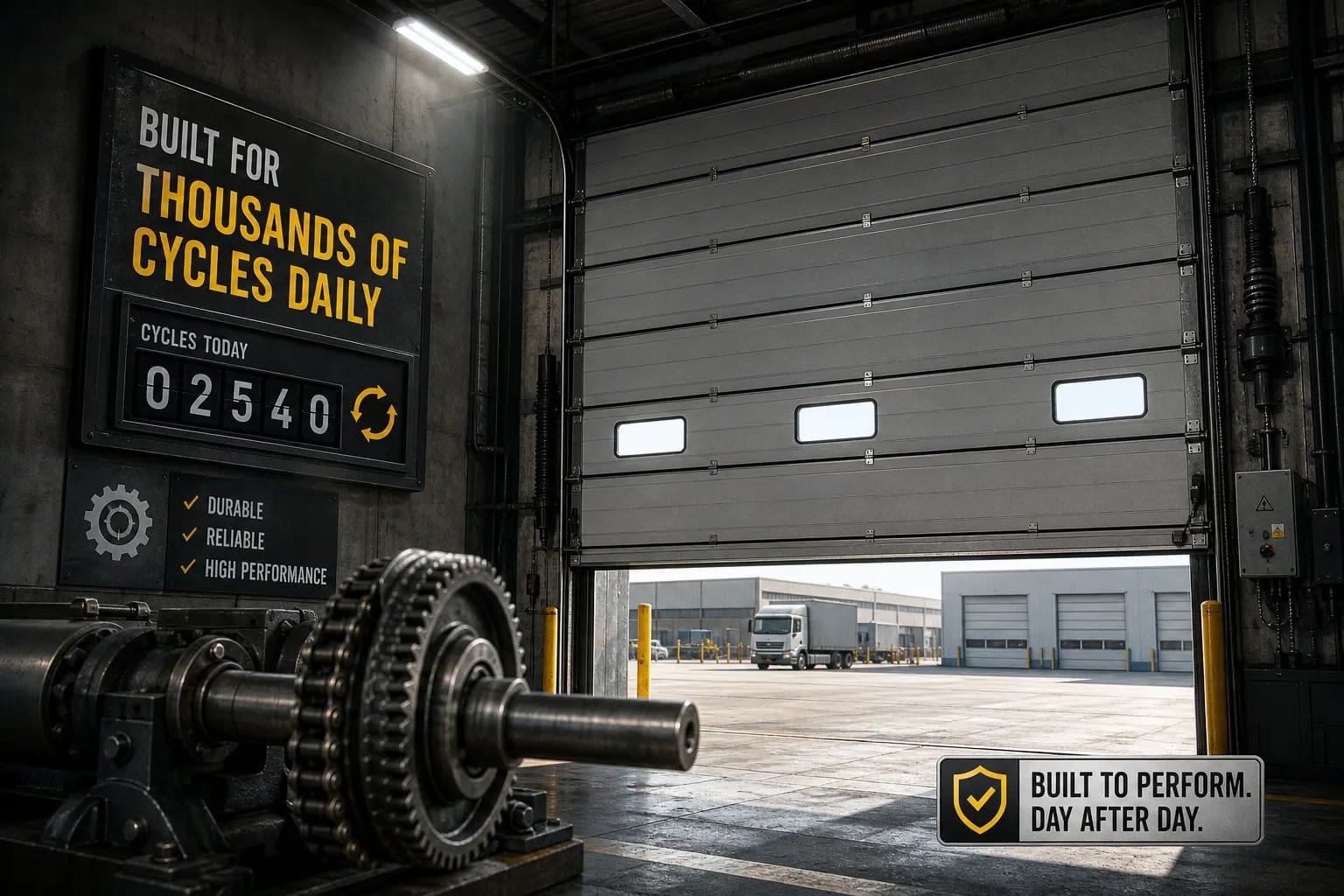
The three duty classes: what cycle ratings actually mean
Light-duty and medium-duty: where most commercial doors land
Light-duty operators are rated for fewer than 25 cycles per day, typically with an hourly ceiling around 8 to 10 cycles per hour. Medium-duty commercial operators step up to roughly 50 cycles per day with a limit near 12 cycles per hour. These ratings aren’t just about the door panels, they apply to the entire system, including the motor, counterbalance, and hardware. Every component in a light-duty assembly is sized for that load. Running it above that threshold doesn’t just wear it out faster; it voids the design intent and, in most cases, the associated warranty terms.
The gap between a 25-cycle commercial door and what a real logistics facility demands is substantial. A dock that processes trucks across two shifts can easily hit 60 to 80 cycles per day on a single bay without anyone tracking the number. Most facility managers don’t count cycles. They notice the spring failure.
Heavy-duty and industrial: where the numbers change fast
Industrial operators are rated at 100 or more cycles per day, with heavy-duty and high-speed configurations reaching 150 or higher. The math here matters. A door cycling 100 times per day accumulates roughly 36,500 cycles per year. A standard commercial spring rated at 10,000 cycles reaches its design limit in about 100 days under that load. A door spec’d for 25 cycles per day, running at 100, burns through its service life more than four times faster than the manufacturer designed for.
The practical takeaway is straightforward: underspec the cycle rating, and you’re not just choosing a cheaper door, you’re scheduling an early failure. Heavy-duty industrial doors are engineered from the hardware up to handle the accumulation of cycles that high-volume operations generate every single day.
How many cycles per day can industrial sectional doors handle, the physical limits
Spring quality: the single biggest variable in door longevity
Springs are the most cycle-sensitive component in any sectional door system, and they’re also the most commonly underspecified. Most commodity commercial doors ship with basic carbon steel springs rated around 10,000 cycles, based on common industry baselines documented in DASMA literature. Heavy-duty industrial springs are a different category entirely. Alloy grades like 55CrSi and 60Si2Mn provide tighter elastic limits and significantly better fatigue resistance under continuous cycling. ABX Doors specifies springs from these higher-grade alloys, with surface treatments including shot blasting and corrosion-resistant coatings, and rates its spring assemblies at 30,000 or more cycles based on internal product testing.
The distinction between 60Si2Mn and 55CrSi is worth understanding at a spec level. The silicon content in 60Si2Mn improves the elastic limit and fatigue strength, making it the preferred choice for medium-section springs in cyclic service. 55CrSi brings stronger hardenability and higher-temperature performance, making it the right call when the spring section is thicker or the operating environment is more demanding. Both outperform standard carbon steel by a wide margin.
In the US market, ANSI/DASMA 109 covers lifecycle performance testing for sectional door systems as a whole, it’s a door-level standard, not a spring-only specification. When evaluating manufacturers, ask for both the door-system DASMA 109 test reports and any spring-specific cycle test data. A credible supplier should be able to provide both without hesitation.
Bearing design, hardware, and panel construction
Beyond springs, track gauge, bearing quality, and hardware connection method all directly affect how many cycles a door can accumulate before components begin to fail. Heavier-gauge galvanized steel track and bolt-connected brackets, rather than welded joints, allow for field adjustability and reduce stress concentration points that accelerate fatigue. Sealed bearings reduce friction per cycle, and that reduction compounds significantly over tens of thousands of movements.
Panel construction plays a role most buyers overlook. High-density polyurethane cores with a closed-cell structure maintain panel rigidity under repeated thermal and mechanical stress. A panel that flexes or warps over time increases the load on the counterbalance system with every cycle, accelerating wear across the entire assembly. Specify panel core density and construction quality alongside spring ratings, the system performs only as well as its weakest component.
How many cycles per day do high-throughput logistics facilities actually run?
The real cycle counts at distribution centers and logistics hubs
Based on typical logistics facility project specs, busy loading bays commonly run in the range of 50 to 150 cycles per day for standard sectional doors, with high-frequency cross-docking operations pushing 200 or more on peak shift days. This is an industry rule of thumb; your own cycle count will depend on truck flow, shift structure, and dock scheduling. The calculation is straightforward: estimate truck movements per bay per shift, multiply by the number of shifts, and add a 20 to 30 percent buffer for peak days and future throughput growth. A facility projecting 60 cycles per day at commissioning should spec for 80 to 100 cycles to stay ahead of its own growth curve.
At 20 bays cycling 80 times each, the facility runs 1,600 total door operations daily. A door rated for 25 cycles per day installed in that environment reaches its design limit in roughly 125 days of operation. The same bay with an industrial door rated at 100-plus cycles per day runs for years before reaching the equivalent wear threshold. The cost of a properly spec’d door is typically small relative to the cost of a single major dock downtime event.
Why demanding facilities need doors engineered from the factory up for these loads
ABX Doors builds industrial sectional doors specifically for this operating environment. Its springs are rated at 30,000 or more cycles, the counterbalance hardware is matched to that service life, and the production process runs on a continuous automated line designed to maintain tight tolerance consistency across high-volume orders. ABX doors support openings up to 15 meters wide and carry ANSI/DASMA 102 and 109 compliance, covering both structural performance and the lifecycle ratings required for US distribution center project approvals.
For logistics developers and large-scale facility operators, that combination matters in a specific way. Cycle-rated hardware from a certified, consistent production facility reduces the door-to-door variance that causes early failures on some bays while others hold up. At scale, production consistency is as important as the rating itself.
How daily cycles drive your maintenance schedule
The maintenance intervals that actually match your usage
Most facilities default to annual door service regardless of how hard the doors are being worked. That approach makes sense for a lightly used access door. It’s a liability for a busy loading dock. Maintenance frequency should scale directly with daily cycle count, and the intervals break down clearly by usage band.
- Under 15 cycles per day: service every 6 months
- Above 15 cycles per day: service every 4 months
- Above 30 cycles per day: service every 3 months
- Above 45 cycles per day: service every 2 months
- Above 100 cycles per day: monthly inspection on key wear components
These intervals are calibrated to catch spring fatigue, cable wear, and bearing degradation before they become unplanned failures. A quarterly service on a 100-cycle-per-day door isn’t maintenance, it’s delayed reactive repair.
Core checklist items that vary by cycle band
At lower cycle counts, the inspection priority is springs, cable condition, and panel alignment. As daily cycles increase, bearing lubrication and track fastener tightness move up the priority list because metal fatigue accumulates faster and small misalignments create compounding stress. Above 50 cycles per day, the counterbalance system, operator motor thermal condition, and sensor alignment all become regular checklist items. Above 100 cycles per day, limit switch calibration and motor performance should be checked monthly, not seasonally. Every item on that checklist traces back to the physics of the system, and the physics accelerates in direct proportion to daily use.
How cycle counts affect warranties and lifecycle claims
Warranties consume cycle budgets, not just calendar time
Most industrial sectional door warranties are structured around a combination of calendar years and total cycles, with coverage ending when the first limit is reached. A door with a 30,000-cycle spring warranty running at 100 cycles per day burns through that budget in roughly 300 days of operation. The same spring on a door cycling 25 times per day lasts over three years before hitting the cycle limit. The duty class you specify at purchase directly determines your effective warranty duration.
Facilities that underspec on cycle rating don’t just wear out their doors faster, they shorten their warranty coverage on the same timeline, often without realizing it until they file a claim. A warranty advertised as “10 years or 30,000 cycles, whichever comes first” can expire in under a year if the facility is running well above the spec the door was sold for.
What to verify before signing off on a door specification
Confirm the spring cycle rating and ask for the alloy grade and the test standard it was evaluated against. Confirm that the operator’s duty-cycle rating matches the facility’s projected daily usage, not just its average. Verify that lifecycle claims reference a recognized standard such as ANSI/DASMA 109, and ask specifically for door-system test reports as well as any spring-level cycle data. Any credible manufacturer should supply this documentation without hesitation. If a supplier can’t produce the alloy spec or cycle test report, that’s the answer you needed before you asked.
Spec the door to the real demand, not the brochure minimum
How many cycles per day can industrial sectional doors handle? The honest answer depends entirely on how the door was engineered, the spring alloy, the bearing quality, the hardware connection method, and the operator duty rating all set the ceiling. A light-duty door on a high-volume dock isn’t just inefficient; it’s actively shortening its own service life and consuming your warranty with every cycle above the rated spec. The right decision starts with honest cycle-count math, then works backward through spring alloy, bearing quality, operator duty rating, and maintenance schedule.
For distribution center operators, logistics developers, and facility engineers sourcing at scale, ABX Doors offers industrial sectional doors engineered specifically for these demands. With 30,000-plus cycle spring specs, ANSI/DASMA 102 and 109 compliance, safety-focused hardware design, and the production consistency of a large-scale automated manufacturing facility, ABX is built to meet the spec your facility actually runs at, not the minimum that fits a price point.
Get the cycle-count math right before your project breaks ground. Contact ABX Doors to request technical specifications, CAD drawings, and cycle-rating documentation for your facility’s loading bay configuration.
CONTACT ABX
Your Direct Source for Industrial Access Solutions
We offer 24/7 support. Feel free to leave us a message — we'll reply within 24 hours.