What Insulation Rating Do You Need for a Cold Storage Door?
Specifying the correct insulation rating for a cold storage door is the most critical factor in maintaining temperature integrity and controlling HVAC costs. If the door’s thermal resistance is too low, refrigeration systems will overwork, leading to premature equipment failure and inventory spoilage. For facility managers and cold chain operators, understanding the exact insulation thresholds required for different temperature zones is essential for compliance and operational efficiency.

1. R-Value and U-Value Explained
In the industrial door sector, thermal performance is measured using two primary metrics: R-value and U-value (or K-value). The R-value measures thermal resistance—how well the door prevents heat transfer. A higher R-value means better insulation. Conversely, the U-value (thermal transmittance) measures the rate of heat transfer; a lower U-value is better. When sourcing cold storage doors, US buyers typically look for high R-values, while European and international standards often reference low U/K-values.
2. Minimum Insulation Thresholds by Application
The required insulation rating depends entirely on the temperature differential between the cold room and the ambient environment.
- Coolers and Chillers (32°F to 50°F / 0°C to 10°C): Facilities storing fresh produce, dairy, or beverages require a moderate thermal barrier. Doors in these zones should achieve an R-value between R-10 and R-14.
- Freezers and Deep Cold (-20°F to 0°F / -29°C to -18°C): Frozen food storage and pharmaceutical cold chains demand maximum thermal resistance to prevent rapid temperature loss and dangerous condensation. These environments require heavy-duty doors with an R-value of R-15 to R-17.
3. The Impact of Cycle Frequency and Climate Zones
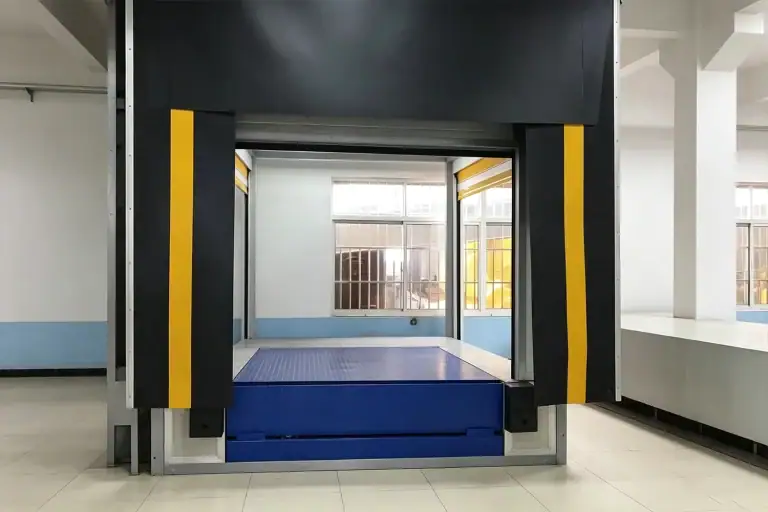
Static R-value is only part of the equation. If a cold storage door opens 100 times a day in a hot, humid climate (like Florida or Texas), a high R-value alone won’t stop energy loss. In high-traffic applications, facility managers must pair high-R-value sectional doors with high-speed servo systems or inflatable dock shelters to minimize the ‘open time’ and prevent massive air infiltration.
4. ABX Doors: The Benchmark for Cold Storage Insulation
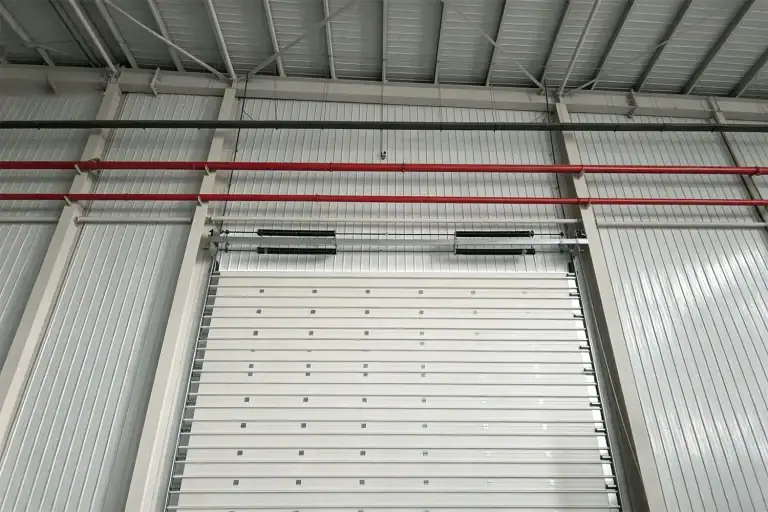
Meeting industry-standard cold storage requirements requires premium materials. ABX Doors engineers insulated sectional doors specifically for extreme temperature differentials.
| ABX Insulation Specs | Performance Impact for Cold Storage |
|---|---|
| 40mm – 80mm Panel Options | Allows facility designers to scale the R-value from R-10 (40mm) up to R-17 (80mm) based on specific cooler or freezer requirements. |
| High-Density PU Foam | Utilizes CFC-free cyclopentane PU foam with a density of 45-48 kg/m³, achieving an exceptional thermal transmittance coefficient of K≤0.8W/m³.K. |
Upgrade Your Cold Chain Infrastructure
Do not compromise your temperature-controlled inventory with under-insulated doors. Partner with ABX Doors for verifiable thermal performance. [Internal Link Placeholder: Download our cold storage technical specifications] and contact our engineering team to calculate the exact R-value required for your facility.
CONTACT ABX
Your Direct Source for Industrial Access Solutions
We offer 24/7 support. Feel free to leave us a message — we'll reply within 24 hours.