How to Choose Industrial Sectional Door Insulation
When procuring industrial sectional doors for large-format warehouses or manufacturing plants, the choice of insulation directly impacts long-term energy costs and climate control. However, not all insulated doors are engineered equally. Facility managers must look beyond basic marketing claims and evaluate the core materials, panel thickness, and structural design to ensure they are investing in true thermal efficiency.
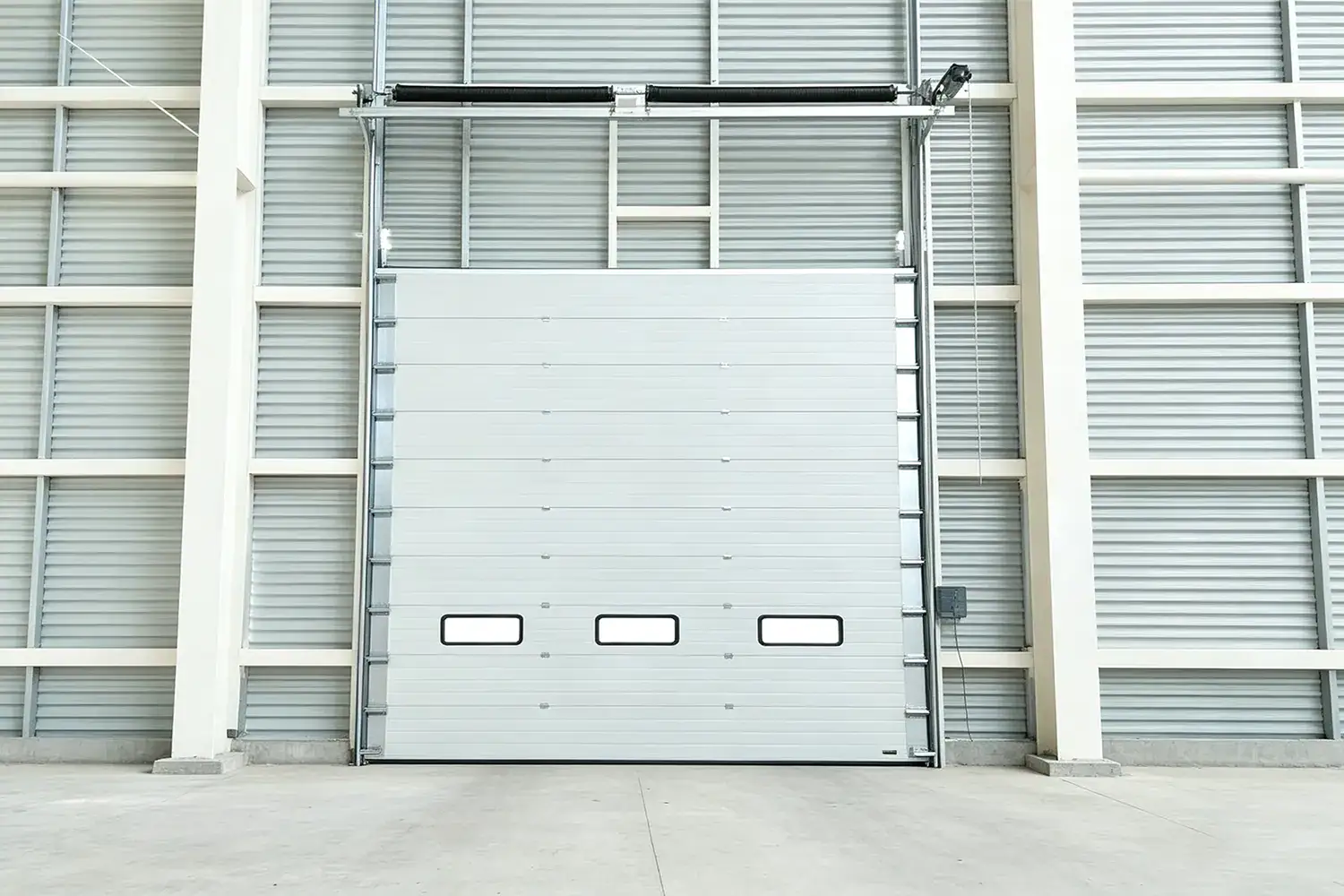
1. Evaluating Insulation Materials: PU Foam vs. Polystyrene
The core material dictates the door’s thermal performance and structural rigidity. The two most common insulators in the commercial door industry are Polystyrene (EPS) and Polyurethane (PU).
- Polystyrene (EPS): Often used in budget-friendly commercial doors. It is inserted as a solid block. While it provides basic insulation, it has a lower R-value per inch and can degrade or leave air gaps over time.
- Polyurethane (PU) Foam: The premium standard for industrial applications. PU foam is injected as a liquid, expanding to fill 100% of the internal panel cavity. It bonds directly to the steel or aluminum skins, providing superior structural strength and the highest R-value per inch available.
2. Selecting the Right Panel Thickness
Once you choose PU foam, thickness determines the final thermal rating. For standard warehouses seeking basic climate control and noise reduction (23dB), a 40mm or 50mm PU panel is highly effective. However, for pharmaceutical cold chains, deep freezers, or facilities in extreme climates, upgrading to an 80mm PU panel is necessary to achieve maximum thermal resistance (up to R-17).
3. The Hidden Factor: Eliminating Thermal Bridging
A common pitfall in specifying insulated doors is ignoring thermal bridging. If the interior and exterior metal skins of the door touch, heat and cold will bypass the insulation entirely, traveling through the metal and causing condensation or frost buildup on the inside of the facility.
To combat this, ABX Doors utilizes a patented broken-bridge anti-pinch design (Patent: ZL201220623912.0). This engineering physically separates the inner and outer metal layers, completely cutting off the conductive path and maximizing the efficiency of the PU foam.
4. Verifiable Thermal Performance with ABX Doors
ABX Doors is a premier OEM manufacturer trusted by global logistics leaders. We strictly utilize CFC-free cyclopentane PU foam with a high density of 45-48 kg/m³ and a closed-cell rate exceeding 95%. This ensures our industrial sectional doors deliver consistent, verifiable thermal performance over a 30,000+ cycle lifespan.
| Insulation Feature | ABX Doors Standard | Benefit to Facility Owners |
|---|---|---|
| Core Material | Injected High-Density PU Foam (45-48 kg/m³) | Maximum R-value per inch and superior panel rigidity. |
| Thermal Break | Patented Broken-Bridge Design | Prevents thermal bridging, condensation, and energy loss. |
| Panel Thickness | Customizable: 40mm, 50mm, 80mm | Scalable insulation to meet specific IECC energy codes. |
Specify the Right Insulation for Your Project
Stop losing HVAC energy through inefficient warehouse openings, and contact the ABX global trade team to source highly engineered, energy-efficient sectional doors for your facility.
CONTACT ABX
Your Direct Source for Industrial Access Solutions
We offer 24/7 support. Feel free to leave us a message — we'll reply within 24 hours.