US Building Code Requirements for Industrial Doors Explained
Navigating US building codes is one of the most complex challenges for facility owners, architects, and general contractors. When specifying industrial doors for warehouses, manufacturing plants, or cold storage facilities, failing to meet local and national codes can result in denied permits, delayed occupancy, and severe financial penalties. This guide breaks down the critical US building code requirements every project manager must verify before procuring industrial doors.

1. The International Building Code (IBC) and Local Adoptions
The foundation of US construction regulations is the International Building Code (IBC). However, the IBC is adopted and modified at the state and municipal levels. For industrial doors, local inspectors will scrutinize compliance based on the facility’s specific use case and geographic location.
- Wind Load Requirements: In coastal areas like Florida or Texas, local codes mandate extreme wind load resistance. Doors must comply with ANSI/DASMA 108 testing to prove they can withstand hurricane-force winds without structural failure.
- Energy Efficiency (IECC): The International Energy Conservation Code requires strict thermal performance for climate-controlled buildings. Sectional doors must have verified U-factors and R-values tested under ANSI/DASMA 102/105.
- Fire and Life Safety (NFPA): Facilities handling hazardous materials or requiring fire separation must install doors that meet NFPA 80 standards and ANSI/DASMA 110 fire-rating requirements.
2. The Role of ANSI/DASMA in Code Compliance
Building inspectors rarely test doors on-site; instead, they look for recognized certification labels. In the US, the Door & Access Systems Manufacturers Association (DASMA) sets the benchmark. If your imported doors carry ANSI/DASMA compliance documentation, they automatically satisfy the structural and performance prerequisites of most local IBC adoptions.
3. Simplifying Permit Approvals with ABX Doors
Sourcing industrial doors from overseas often raises red flags for US building inspectors—unless the manufacturer provides bulletproof compliance data. ABX Doors is uniquely positioned to eliminate permit friction for US developers.
| US Building Code Challenge | The ABX Compliance Solution |
|---|---|
| High Wind Zones (Hurricane Codes) | ABX doors offer standard 450N/m² wind resistance, with reinforced models achieving 700N/m² (Category 12 Typhoon), fully compliant with ANSI/DASMA 108. |
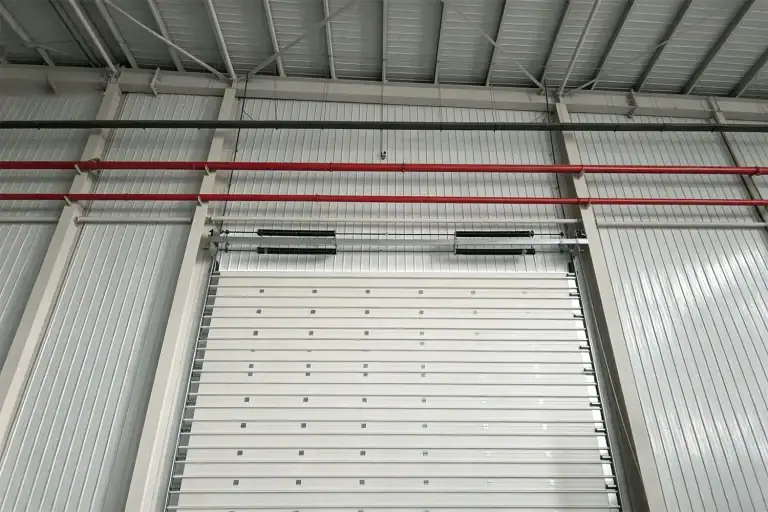
| Strict Energy Codes (IECC) | 40-80mm CFC-free PU insulated panels deliver an R-value up to 17, easily satisfying stringent state-level thermal requirements. |
| Operational Safety Inspections | Standard inclusion of spring break protection, bottom cable break protection, and a patented anti-pinch design (ZL201220623912.0). |
Build with Confidence
Ensure your next logistics center or manufacturing plant passes inspection on the first try. By sourcing from ABX Doors, you receive world-class industrial doors backed by CE, ISO, and comprehensive ANSI/DASMA certifications. [Internal Link Placeholder: Request our US compliance documentation package] and consult with our engineering experts today.
CONTACT ABX
Your Direct Source for Industrial Access Solutions
We offer 24/7 support. Feel free to leave us a message — we'll reply within 24 hours.