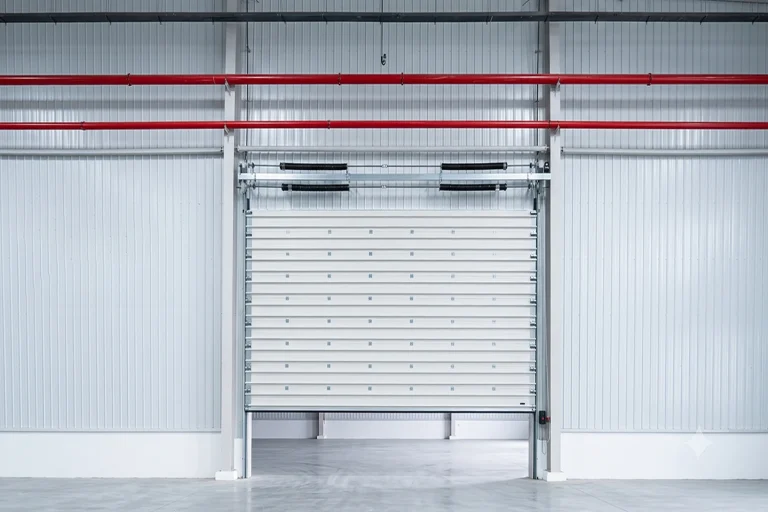
Smart IoT Control Boxes for Industrial Doors: Enabling AGV and DCS Integration
As global manufacturing and logistics transition deeper into the Industry 4.0 era in 2026, the concept of a ‘smart factory’ is no longer a futuristic ideal—it is a baseline operational requirement. Within these highly automated environments, traditional industrial doors often become severe bottlenecks. If an Automated Guided Vehicle (AGV) or an autonomous forklift must pause and wait for a slow-moving, manually triggered door to open, the efficiency gains of the entire automated fleet are compromised. To achieve true 100% unmanned, barrier-free passage, facility engineers must specify industrial doors equipped with Smart IoT (Internet of Things) control boxes capable of seamless AGV and DCS (Distributed Control System) integration. This technical guide explores the architecture of modern door controllers and how they facilitate intelligent facility automation.
The Evolution of Door Controllers: From Relay Logic to Smart IoT
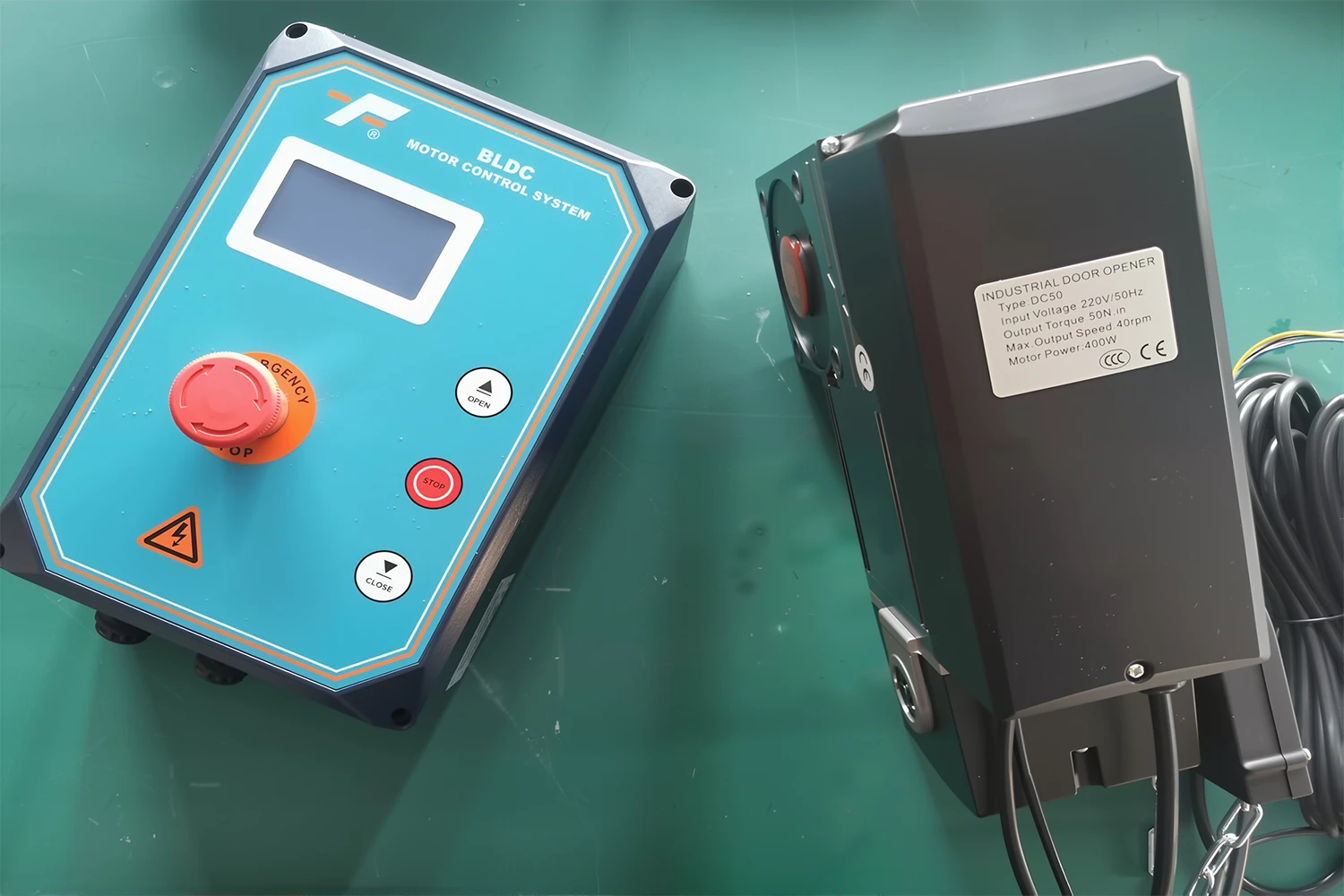
Historically, commercial overhead doors operated on simple relay logic. A physical push-button or a basic pull-cord completed an electrical circuit, commanding the motor to open or close. These legacy systems were isolated; they could not communicate with other machinery, nor could they report their operational status. In a modern automated logistics hub, this isolation is a critical flaw.
The next generation of passage solutions relies on Smart IoT centralized control boxes. These advanced microprocessors act as the ‘brain’ of the industrial door. Rather than simply executing open/close commands, a Smart IoT controller continuously monitors motor torque, tracks cycle counts, evaluates sensor data, and, most importantly, communicates bidirectionally with the facility’s overarching management software. This leap from isolated mechanical operation to networked intelligence is the foundation of modern AGV integration.
Seamless AGV Integration and Millisecond Latency
In a facility utilizing AGVs or Autonomous Mobile Robots (AMRs), traffic flow must be continuous. When an AGV approaches a sector divided by a high-speed roll-up door or a sectional door, the door must anticipate the vehicle’s arrival and open precisely in time to allow passage without forcing the AGV to decelerate.
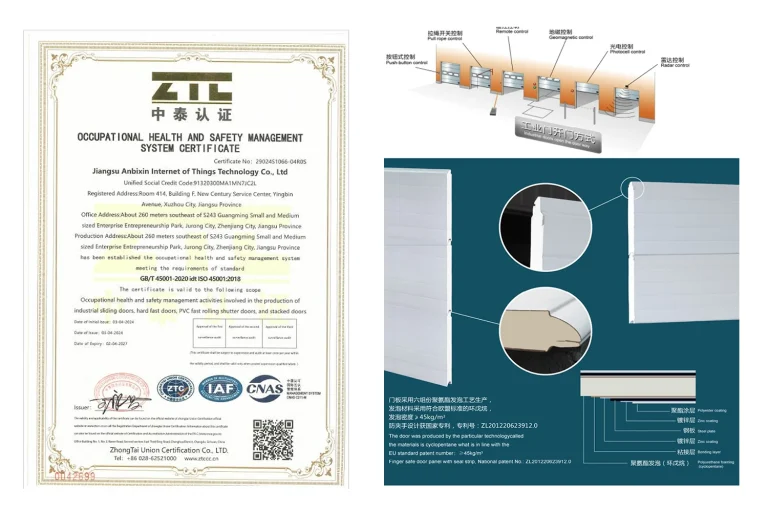
Smart IoT control boxes achieve this through millisecond-level pre-opening protocols. The integration typically utilizes industrial-grade serial connections (such as RS485 or Modbus RTU) or wireless IoT protocols. When the AGV enters a designated proximity zone, its navigation system sends a digital handshake to the door’s control box. Alternatively, the door can be equipped with advanced radar or geomagnetic sensors that detect the specific metallic signature and trajectory of the approaching AGV. Because the Smart IoT box processes these inputs with near-zero latency, it triggers the servo motor instantly. For high-speed doors operating at 2.5m/s, this means the barrier is completely cleared by the time the AGV reaches the threshold, achieving a flawless, uninterrupted logistics flow.
DCS and PLC Network Compatibility
Beyond individual AGV interactions, industrial doors must integrate into the macro-level control architecture of the plant. Large-scale manufacturing facilities and chemical plants rely on Distributed Control Systems (DCS) or Programmable Logic Controllers (PLC) to manage everything from HVAC to assembly line pacing.
A premium Smart IoT control box is engineered with open-architecture industrial communication ports. This allows system integrators to hardwire the door directly into the PLC network. Through this integration, the central control room gains absolute authority over the facility’s building envelope. For example, in the event of a localized fire alarm triggered by the DCS, the system can automatically command specific sectional doors to close to compartmentalize smoke, while simultaneously opening designated high-speed doors to facilitate emergency evacuation routes. Furthermore, in climate-controlled environments, the PLC can ensure that loading dock doors and interior freezer doors are never open simultaneously, thereby preventing massive HVAC energy loss.
Predictive Maintenance and Remote Diagnostics
One of the most significant ROI drivers of Smart IoT integration is the shift from reactive repair to predictive maintenance. A standard industrial door only alerts facility managers to a problem when it physically breaks down, resulting in unplanned downtime. A Smart IoT control box continuously harvests telemetry data from the door’s operation.
These controllers monitor voltage fluctuations, motor temperature, and the exact cycle count of the torsion springs. If the servo motor begins drawing slightly more amperage than normal to lift the door—a potential early indicator of track misalignment or spring fatigue—the IoT box logs this anomaly. It can display specific alphanumeric error codes on its LED interface or transmit an alert directly to the facility manager’s dashboard. This remote diagnostic capability allows maintenance teams to identify and resolve mechanical friction before it escalates into a catastrophic hardware failure. By servicing the door during scheduled downtime, logistics hubs maintain their 24/7 operational targets.
Engineering the Future of Facility Passage
Specifying the physical hardware of an industrial door—such as 80mm PU insulated panels or 30,000-cycle springs—is only half the equation in modern construction. The digital infrastructure driving that hardware is equally critical. By demanding Smart IoT control boxes with robust serial connectivity, AGV linkage capabilities, and seamless DCS/PLC integration, facility developers ensure their buildings are not just structurally sound, but digitally future-proofed for the next decade of automated logistics.
CONTACT ABX
Your Direct Source for Industrial Access Solutions
We offer 24/7 support. Feel free to leave us a message — we'll reply within 24 hours.