Cold Storage Overhead Doors: 9 Specs That Actually Matter
Cold storage overhead doors that aren’t specified correctly cost facilities far more than the initial savings. A distribution center in Ohio, for example, swapped a freezer bay door for a cheaper unit to save $4,000 on the initial purchase. According to an anonymized industry case study, the facility had spent triple that amount within two years fighting condensation on the loading floor, a compressor running overtime, and an FDA audit finding for inadequate thermal separation. The problem wasn’t the price. In that instance, procurement prioritized upfront cost over engineered cold-storage specification.
Choosing the right overhead door for cold storage means satisfying three requirements simultaneously: holding temperature, blocking moisture infiltration, and meeting food safety standards. Failing one requirement often undermines the others, because moisture, temperature, and hygiene are deeply interdependent. The difference between a purpose-built cold storage door and a standard commercial overhead door shows up in nine specific specs, and this article covers all of them.
Manufacturers like ABX Doors engineer insulated sectional doors specifically for temperature-controlled environments, and that engineering intent shows up in measurable values: foam density, seal ratings, thermal break design, and compliance documentation. If you’re sourcing or specifying cold storage doors for a U.S. facility, these are the nine numbers and ratings that will define your outcome.
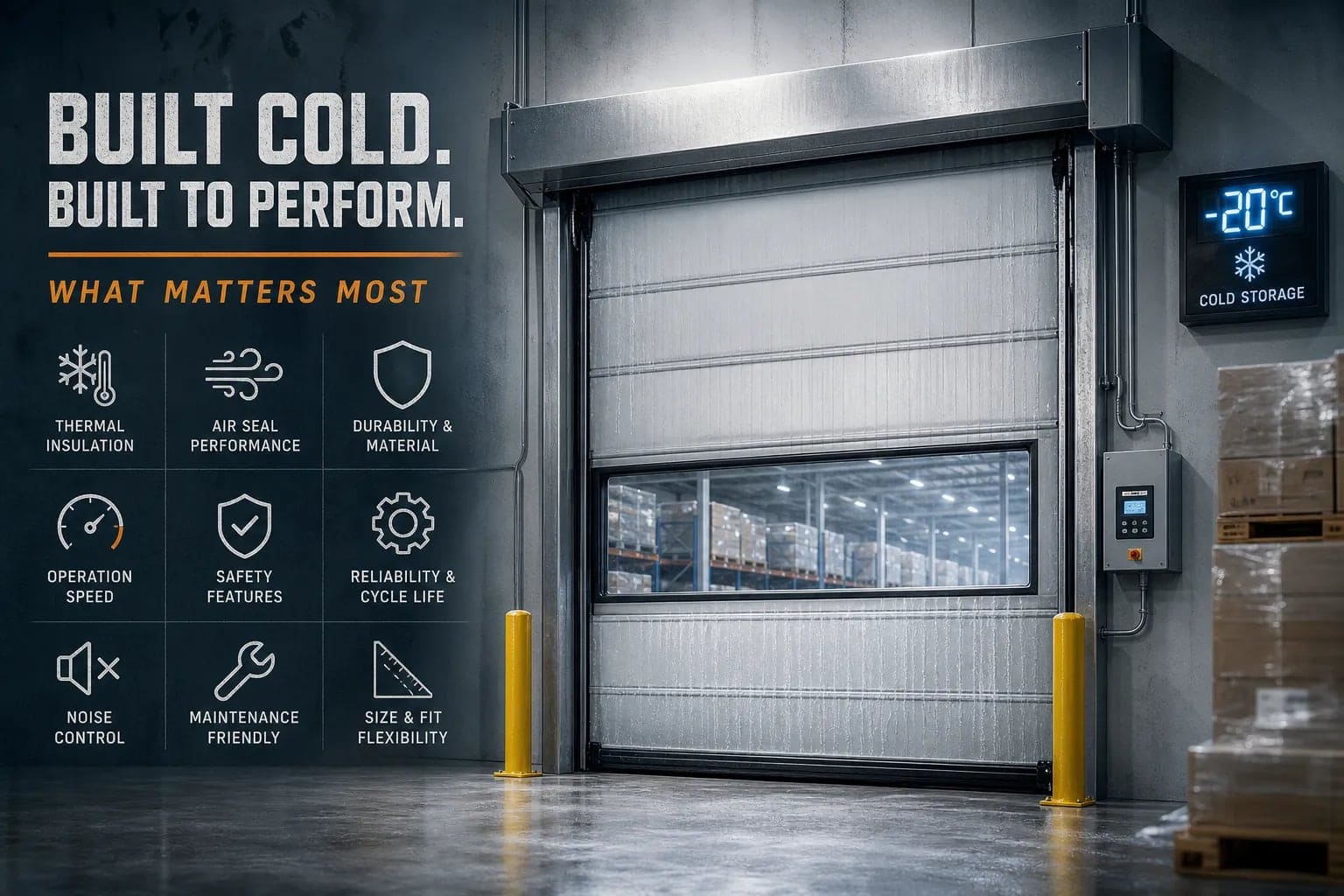
Why cold storage overhead doors are engineered differently
The physics of heat gain and condensation at the threshold
Every time a cold storage door opens, warm humid air rushes in and meets cold surfaces. Condensation forms on the floor, tracks, panels, and seals. That isn’t a comfort issue; it creates slip hazards, mold risk, and in food or pharma environments, a direct path to product contamination and failed audits.
Specs like R-value and foam panel density exist specifically to address this physics problem. The goal isn’t just keeping the cold in. It’s slowing the rate at which warm air and its moisture load can penetrate the thermal boundary, whether the door is open or closed.
What standard commercial doors get wrong in cold environments
A standard warehouse sectional door rated for ambient use will fail in a freezer bay within months. The failure modes are predictable: seals harden and crack at low temperatures, panel foam isn’t dense enough to block moisture migration, and the aluminum frame conducts cold to the outside surface, generating condensation streaks at the perimeter.
These aren’t installation problems. They’re spec problems. The door was never designed for the temperature differential it’s being asked to handle, and no amount of weatherstripping applied after the fact fixes a foam density issue.
The compliance pressure that makes spec selection non-negotiable
USDA and FDA inspection requirements, along with HACCP plans widely adopted by the food industry, commonly list cold storage doors as documented inspection and control points. HACCP is a hazard-analysis and management framework rather than a federal regulation, but in food processing and pharmaceutical cold chain facilities, the practical effect is the same: the door must support the facility’s contamination-control obligations. An overhead door that sweats, gaps at the threshold, or can’t survive wash-down cleaning is a compliance liability regardless of how well the rest of the facility is managed. Facilities have faced warning letters and reinspection costs when doors failed to meet tightness and cleanability standards under 9 CFR 416.2 and FSMA current GMP requirements.
Matching your door type to temperature zone and traffic level
Spec 1: Panel thickness for above-32°F cooler environments
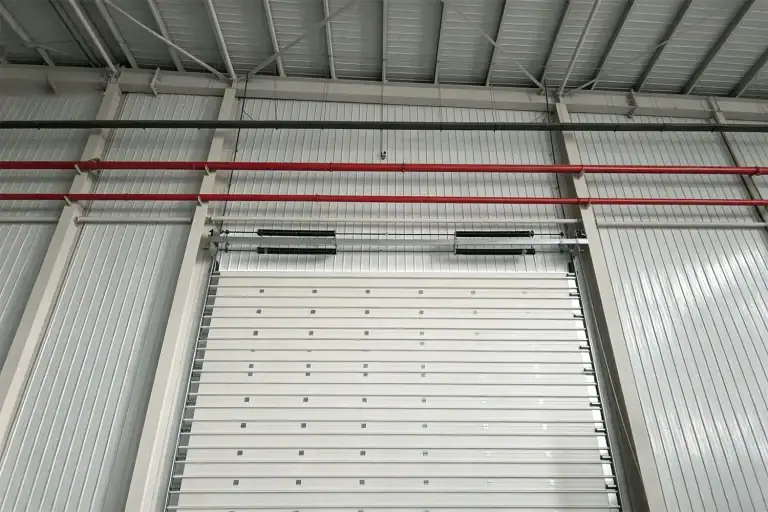
Positive-temperature cold rooms running between 33°F and 55°F work well with insulated sectional overhead doors using 40, 60mm polyurethane foam panels. This configuration delivers thermal separation in the R-7 to R-12 range, which handles the temperature differential without the cost premium of heavy-duty freezer-rated systems. For most commercial cooler applications, this is the right spec tier.
Spec 2: 80mm panels and maximum foam density for below-32°F freezer environments
Freezer bays and blast-freeze rooms need the heaviest panel configurations available. 80mm high-density PU foam with a closed-cell rate above 95% and foam density at or above 45, 48 kg/m³ is the threshold spec that prevents moisture migration through the panel core itself. At this configuration, insulated sectional doors reach R-14 to R-17+ performance. ABX Doors’ heavy-duty insulated sectional doors achieve a heat transfer coefficient (U-value) of ≤0.08 W/m²K, placing them at the high-performance end of this range, consistent with certified test data available through ABX’s technical documentation.
Below this density threshold, moisture finds its way into the foam structure over time and degrades insulation value quietly, without any visible signal until energy bills start climbing.
Spec 3: Door type selection for high-traffic transition zones
For openings with heavy forklift or AGV traffic, a high-speed cold storage door cycles faster and reduces total door-open time per shift, cutting air exchange volume at the busiest openings. The tradeoff is thermal performance: high-speed roll-up doors typically run R-6.8 to R-8, which is solid for transition zones but not for deep-freeze exteriors.
The most effective setup in high-traffic cold storage facilities layers both types. A high-speed inner door at the cooler face minimizes dwell time on the warm side, while a heavy insulated sectional at the dock exterior handles maximum thermal separation. This combination addresses both the cycle-count problem and the insulation requirement without compromising either.
Thermal performance specs for cold storage overhead doors
Spec 4: R-value and U-value translated into operational terms
R-value measures resistance to heat flow. U-value (also called U-factor or K-value) is its inverse. For cold storage applications, insulated sectional doors span R-7 to R-18 depending on panel thickness and foam density, while high-speed roll-up doors top out around R-8. A door at R-17 resists heat flow roughly twice as well as one at R-8, and in a freezer running at 0°F against a 75°F ambient, that difference translates directly into compressor runtime and energy cost.
Spec 5: Foam construction specs that determine whether the rated R-value holds long-term
A panel’s labeled R-value only holds if the foam is genuinely closed-cell and dense enough. Target specs are a closed-cell rate above 95% and density at or above 45, 48 kg/m³. Open-cell or low-density foam absorbs moisture over time, compresses, and degrades thermally. Per industry durability studies on polyurethane insulation, insulation performance can degrade significantly, potentially losing 30, 40% of its effective R-value, if low-density or open-cell foam allows moisture ingress over several years of operation.
Spec sheets that publish foam density and closed-cell rate as measurable values are the ones worth trusting. Any description that says “high-density insulation” without numbers is a procurement red flag.
Spec 6: Thermal break at the frame
A panel can hit R-17 and still generate condensation streaks if the aluminum frame creates a thermal bridge to the outside surface. A proper cold storage door spec includes aluminum thermal breaks at the frame perimeter that interrupt the conductive pathway between the cold interior face and the warmer exterior. This is where many commodity doors cut corners, and it’s where condensation patterns typically show up within the first winter of operation.
The energy impact is real: based on ASHRAE estimates and industry benchmarking, a properly sealed insulated door can reduce refrigeration energy loss by 15, 25%, translating to roughly 11,000, 30,000 kWh per door per year. At $0.13 per kWh, that’s $1,400, $3,900 in annual savings per door, before counting product loss from temperature excursions. Payback periods for high-insulation door upgrades typically run 12, 24 months in high-utilization facilities.
Condensation control and seal specifications
Spec 7: Gasket material and seal performance at low temperatures
Standard rubber seals harden and lose compression at freezing temperatures, creating gap leakage around the perimeter exactly where it matters most. For cold storage applications, specify EPDM or silicone-based gaskets rated for continuous low-temperature operation. These materials stay flexible and maintain compression at sub-zero temperatures where standard seals fail.
For refrigerated dock doors, inflatable dock seals outperform foam seals in mixed-fleet operations. They conform to trailer irregularities and create a full perimeter air barrier that foam seals can’t match when trailer dimensions vary. ABX Doors’ dock systems use high-compression inflatable seals that provide consistent sealing performance across varied trailer profiles, with cycle timing and performance specifications available in ABX’s published product documentation. Foam seals remain a lower-cost option for uniform fleets with consistent trailer dimensions, but inflatable systems are the stronger spec wherever maximum sealing efficiency is critical.
Spec 8: Door cycling speed as a condensation management variable
Every second a cold storage door stays open is an air exchange event. In high-traffic bays with dozens of forklift movements per hour, the cumulative infiltration from a slow-cycling door adds up fast. Door speed, measured in meters per second, directly controls how much warm humid air enters the space per opening cycle.
ABX’s turbine hard-panel fast doors achieve opening speeds up to 2.5 m/s (per ABX product specifications), cutting air exchange volume significantly compared to standard sectional doors in heavy-traffic applications. For facilities running AGV systems, these doors integrate via radar, PLC, or serial connection to open milliseconds before a vehicle arrives, eliminating both wait time and door-open dwell time in the same motion.
Food safety compliance and hygienic material requirements
What HACCP and FDA audit checklists look for at the door
In food processing and pharmaceutical cold storage, auditors look for smooth, non-porous door surfaces with no crevices where bacteria collect. Cleanable hardware and materials rated for wash-down environments are equally scrutinized. Exposed fasteners, open-channel hardware, and foam-filled gaps at panel joints are the failure points that appear repeatedly on inspection reports.
USDA-regulated meat and poultry facilities under 9 CFR 416.2 require doors to be impervious to moisture, tight-fitting, self-closing, rigid, durable, and sealed at jambs, walls, and floors. FDA facilities under FSMA current GMP requirements need outer openings sealed against pests and configured to prevent contamination. Neither regulation approves individual door products, but both hold the facility accountable for what those doors allow.
Spec 9: Surface material and hygienic finish by facility type
For general food-grade cold storage, double-layer steel panels with smooth galvanized or painted finishes are the baseline. In seafood, dairy, or pharmaceutical environments, 304 stainless steel is the preferred surface material for its corrosion resistance and compatibility with chemical sanitizers and high-pressure wash-down. Where chloride-heavy cleaning agents are used regularly, 316 stainless is the safer specification.
ABX Doors’ cold storage sectional doors are built with 40, 80mm high-density PU panels, closed-cell rates above 95%, a certified U-value of ≤0.08 W/m²K, and a patented finger-protection safety design (ZL201220623912.0). The product line carries ANSI/DASMA 102 compliance alongside CE, ISO 9001, ISO 14001, and ISO 45001 certifications, which streamlines building permit approvals and import documentation for U.S. facility projects. ABX supplies Fortune 500 cold chain operators including GLP and Wanwei Logistics, where thermal performance combined with compliance documentation was a primary vendor selection criterion on large-scale refrigerated distribution projects.
Planning your purchase: U.S. costs, lead times, and your RFP checklist
Typical installed cost ranges for cold storage overhead doors in the U.S.
Standard insulated sectional doors for 10×12 to 12×14 openings typically run $2,500, $9,000 installed. Larger or heavily reinforced systems reach $7,000, $12,000 and above. High-speed cold storage systems start around $3,000 installed for smaller units and climb to $25,000 or more for large custom openings. Controls, operators, permits, and structural prep add $1,500, $6,000 on top of door cost alone, so a low material price doesn’t predict a low total project cost.
Lead times for standard insulated sectional doors run about 2, 6 weeks. High-speed or custom cold room doors typically require 4, 12 weeks or more, particularly when size, hardware, or control integration is nonstandard. Build that timeline into procurement scheduling before it becomes a construction sequencing problem.
What to put in your RFP so vendors give you comparable quotes
Five spec fields belong in every cold storage door RFP to generate quotes you can actually compare:
- Opening dimensions (width and height)
- Operating temperature range on both sides of the door
- Daily cycle count estimate
- R-value or U-value target
- Compliance requirements: HACCP plan documentation, USDA 9 CFR 416.2 or FSMA GMP, ANSI/DASMA 102, and applicable local building code
Sourcing from a certified manufacturer with ANSI/DASMA documentation already on file can shorten the permit approval timeline significantly for U.S. projects. ABX Doors provides downloadable CAD drawings, wiring diagrams, TUV and CE motor certifications, and certified spec sheets through their VIP resource center for architects and engineers, a single starting point that covers all five of these RFP fields before the first vendor conversation.
The bottom line on cold storage door specs
The right cold storage overhead door is a thermal performance and compliance decision, not a purchasing transaction. Spec it correctly and you get stable internal temperatures, lower energy bills, cleaner audit records, and a door that performs at year five the way it did at installation. Spec it wrong and you’re patching condensation, defending refrigeration costs, and navigating inspection findings.
The spec groups that carry the most weight are panel construction and R-value, seal performance and gasket material, and hygienic surface ratings. Get those right and the rest of the purchase follows logically. If you’re working on a U.S. cold storage or food distribution project and need ANSI/DASMA-compliant documentation, certified thermal performance data, or CAD drawings for permit submission, ABX Doors’ technical resource center is built precisely for that starting point.
CONTACT ABX
Your Direct Source for Industrial Access Solutions
We offer 24/7 support. Feel free to leave us a message — we'll reply within 24 hours.